Your cat is purring in your lap, you keep stroking a little longer, and she suddenly turns and bites. That bite usually means “stop.” Cats also bite when play gets out of hand, when they’re scared, or when something hurts, and what she does just before the bite usually tells you which.
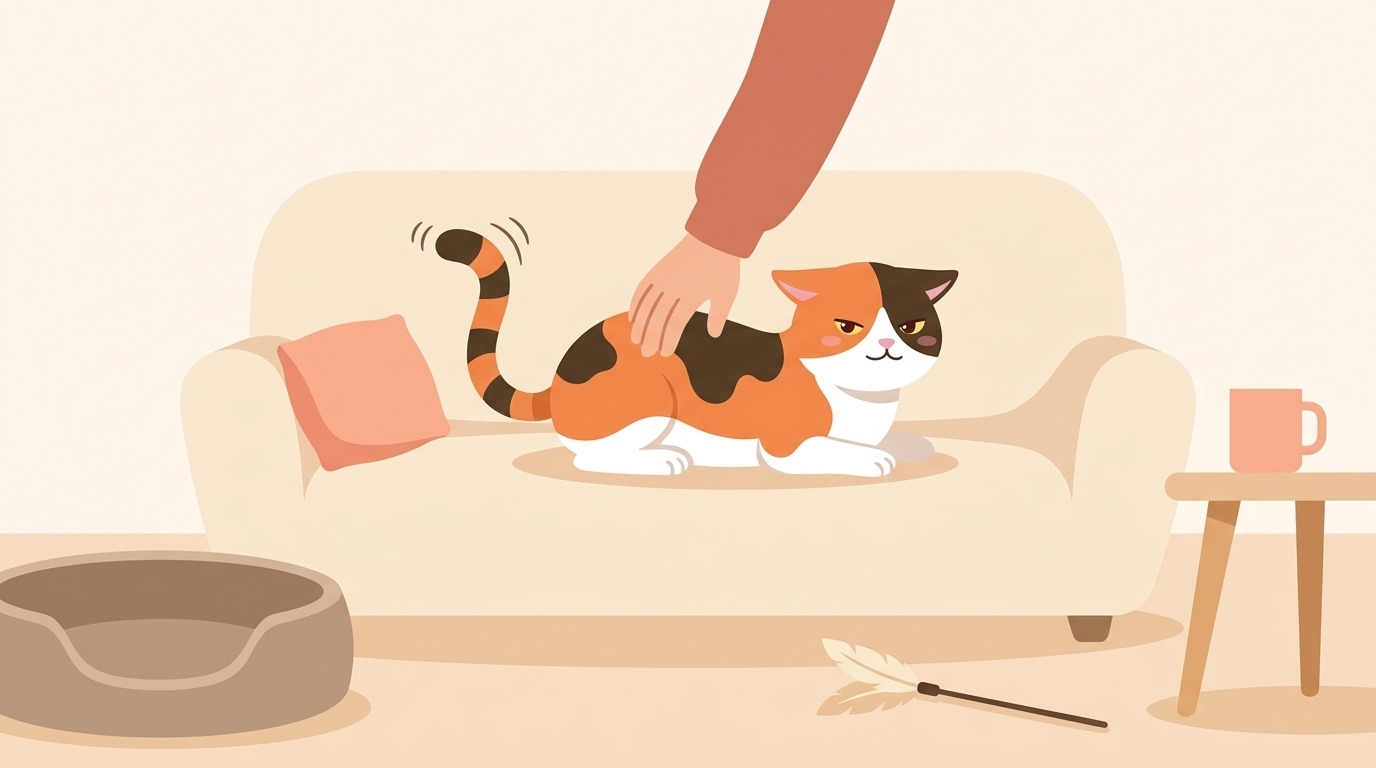
Your cat bites while you pet her: usually too much petting
Many cats warn you with their body language before they bite:
- pupils widening
- tail starting to swish or twitch
- ears turning back, or flicking back and forth
- skin rippling along her back
- going suddenly stiff, or whipping her head around toward your hand
A gentle nip is a warning too. When you see these signs, stop and let her walk away. There’s no need to follow her for more.
Let her come to you, and start with her head, cheeks and chin, the places most cats like to be stroked. Pause every few seconds, and carry on only if she nudges you for more.
Kittens that bite during play
Kittens and cats under about two play rough by nature. She may lie in wait watching your feet, then dash out and pounce as you walk past. A kitten raised without littermates misses the rough-and-tumble that teaches bite control, so she often bites harder.
Playing with her using your hands or feet teaches her that hands and feet are toys. Use a wand toy instead, so your hand stays out of reach. If she pounces and bites, stop and walk away, without touching or punishing her. Pent-up energy makes the pouncing worse, so a good play session every day helps.
Is it play, too much petting, or fear?
To tell them apart, look first at when she bites, then at her body.
| Rough play | Too much petting | Fear | |
|---|---|---|---|
| When she bites | While you walk or move your hands and feet | After a while of being stroked | When she’s cornered and can’t get away |
| What you see first | Watching you from cover, then dashing out to pounce | Tail swishing, ears turning back, skin twitching on her back | Crouching low, ears flattened, hissing, fur standing up |
| What to do | Stop and walk away, then later play with a wand toy | Stop petting and let her leave | Don’t approach; let her calm down on her own |
A cat in rough play can also have wide pupils and ears pressed back, so ears alone won’t tell you. What she was doing just before the bite is the better clue.
Hard bites can mean pain or a fright
A friendly cat that suddenly bites when touched may be hurting somewhere. Arthritis, dental problems and hyperthyroidism can all make a cat more aggressive. If she always bites when one particular spot is touched, that may be where it hurts. A sudden change like this calls for a vet check, especially if she is also eating less or hiding more. The cat pain guide covers more signs of pain.
The other kind is redirected aggression. She sees a stray cat outside the window or is startled by a loud noise, gets worked up, can’t reach the cause, and turns on the nearest person or cat. The bite can come some time later, so it seems to come out of nowhere. If this happens, don’t pick her up or touch her. Step away and leave her alone until she calms down.
If a cat bites you
Cat teeth are thin and sharp, so a bite looks small but goes deep, and bacteria from her mouth are easily carried in. Wash the wound right away with soap and warm water. If the bite breaks the skin, it’s best to see a doctor, especially if it’s on your hand, is deep, or starts to turn red, swollen, warm or more painful. Mention that it was a cat bite.
Frequently Asked Questions
What does it mean when my cat gently bites me? A gentle nip while you’re petting her usually means she’s had enough. You’ll often see her tail start to swish, her ears turn back, or the skin on her back twitch first. Stop then and let her walk away.
Why does my cat bite so hard? Hard bites usually come from fear, play that got out of hand, or pain. A frightened cat crouches, flattens her ears and hisses, so give her space and let her calm down. If a cat who never bit like this suddenly turns aggressive, or bites whenever one spot is touched, have her checked by a vet.
How do I stop my kitten biting? Kittens play rough, and playing with your hands or feet teaches her they’re toys. Use a wand toy instead, and when she pounces and bites, stop and walk away without punishing her. If you’ve just brought a kitten home, Bringing Home a Kitten has more on play.
How do I teach my cat not to bite? Punishment makes a cat more fearful, and more likely to bite. To change the biting, work on why she does it. If she bites partway through petting, it has usually gone on too long, so stop as soon as her tail starts to swish. If she pounces and bites during play, she’s treating hands and feet as toys, so play with a wand toy and stop and walk away when she pounces.
References
- Cornell Feline Health Center. Feline Behavior Problems: Aggression. Cornell University
- ASPCA. Aggression in Cats. ASPCA
- VCA Animal Hospitals. Cat Behavior Problems: Aggression – Petting Aggression. VCA
- VCA Animal Hospitals. Play and Predatory Aggression in Cats. VCA
- VCA Animal Hospitals. How Do I Know if My Cat Is in Pain? VCA
- International Cat Care. Handling and interactions. iCatCare
- International Cat Care. Playing with your cat. iCatCare
- Haywood, C., Ripari, L., Puzzo, J., Foreman-Worsley, R., & Finka, L. R. (2021). Providing Humans With Practical, Best Practice Handling Guidelines During Human-Cat Interactions Increases Cats’ Affiliative Behaviour and Reduces Aggression and Signs of Conflict. Frontiers in Veterinary Science, 8, 714143. PMC
- Ellis, R., & Ellis, C. (2014). Dog and Cat Bites. American Family Physician, 90(4), 239-243. AAFP
- Centers for Disease Control and Prevention. Cats. CDC