Cats are constantly telling us how they feel through body language. We just need to learn how to read it.
Why This Matters
Cats aren’t as obvious as dogs about what they’re feeling, but they’re not as mysterious as people think. When you learn to read their signals, you can:
- Comfort your cat when anxious, preventing stress buildup
- Give them space when they want solitude, building trust
- Detect early behavioral signs of pain or health issues
- Build a deeper bond with your cat
One thing most cat-mood guides skip: signals sit on a continuum, and the same posture can mean very different things depending on context. Ears flat back can mean a cat is irritated, frightened, or in real physical pain. A cat in your living room with no obvious stressor is saying something different from the same cat at the vet, or the same cat alone in a quiet room. Read the signals together, and read the situation around them.
What to Watch
Cat communication runs across the whole body, and no single channel tells you what’s going on by itself. To get a reliable read, combine tail, ears, whiskers, pupils, posture, and any sounds your cat is making with the context they’re in.
The Tail
The tail does a lot of the talking. Position is one part of the picture, but movement and the height of the tail base matter just as much.
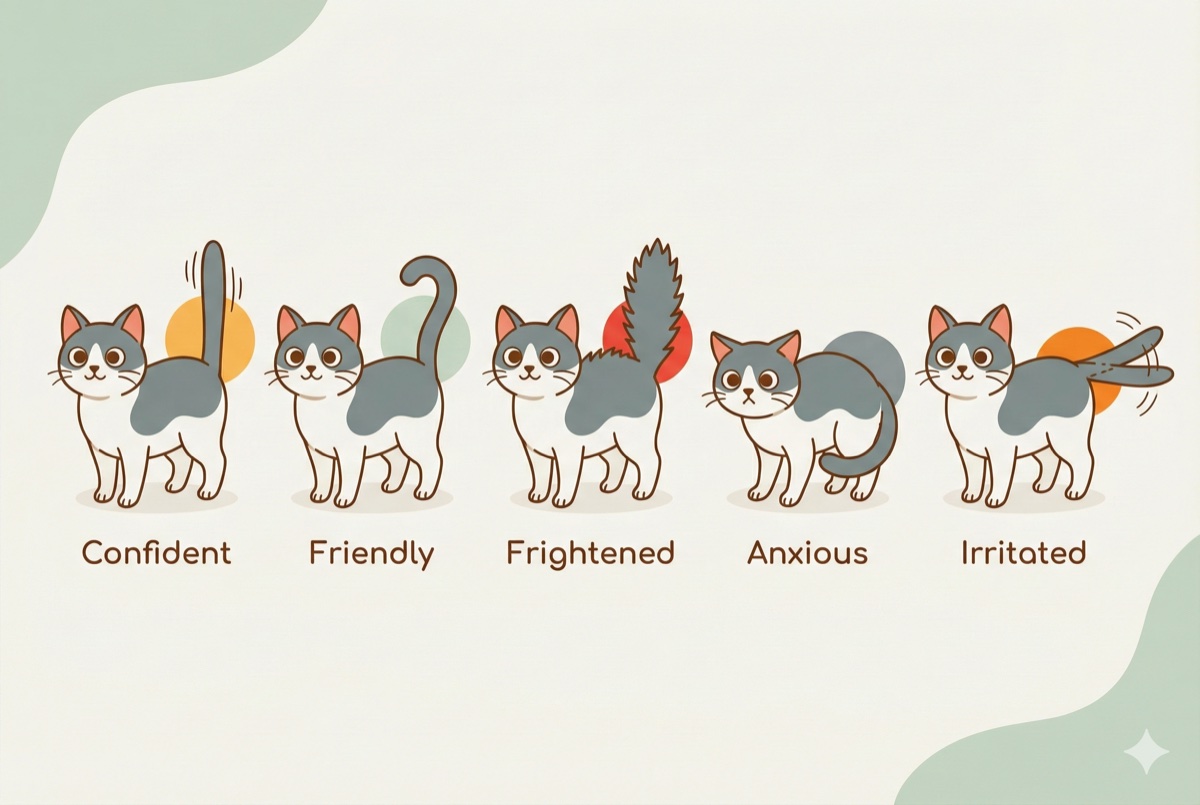
Different tail positions and their emotional meanings
| Signal | What it tends to mean |
|---|---|
| Tail held straight up, base elevated | An affiliative greeting, usually toward a familiar human or cat. Often paired with approach. |
| Tail up with a soft curve or hook at the tip | A relaxed version of the same greeting. Common when your cat is walking toward you with confidence. |
| Tail held horizontally, calm carriage | Neutral, alert, taking in the environment. Not a strong emotional signal on its own. |
| Tail held low, hanging | Wary, uncertain, or simply moving through a space. Depends heavily on the rest of the body. |
| Tail tucked tightly against the body or under the belly | Fear or defensive withdrawal. Not “submission,” which isn’t really a cat concept. |
| Piloerection (tail and back fur stand on end) | High arousal, almost always defensive or threatened. Not playful, despite the cartoon imagery. |
| Fast, large side-to-side lashing | Frustrated, overstimulated, or about to escalate. Stop whatever interaction is happening. |
| Small tip twitch | Mild focus or low-level arousal. Common during play stalks or while watching prey. |
| Tail held upright and quivering rapidly | An excited affiliative greeting, sometimes called “phantom spraying.” Often misread as anxiety or actual marking. |
The biggest tail myth
A swishing or lashing tail is not a happy wag. In cats, fast tail movement almost always signals that arousal is climbing and the cat is close to its tolerance limit. If you see it while petting or playing, stop.
The Ears
Cat ears rotate independently and shift continuously with attention and mood. Treat them as a dial rather than a set of fixed positions.
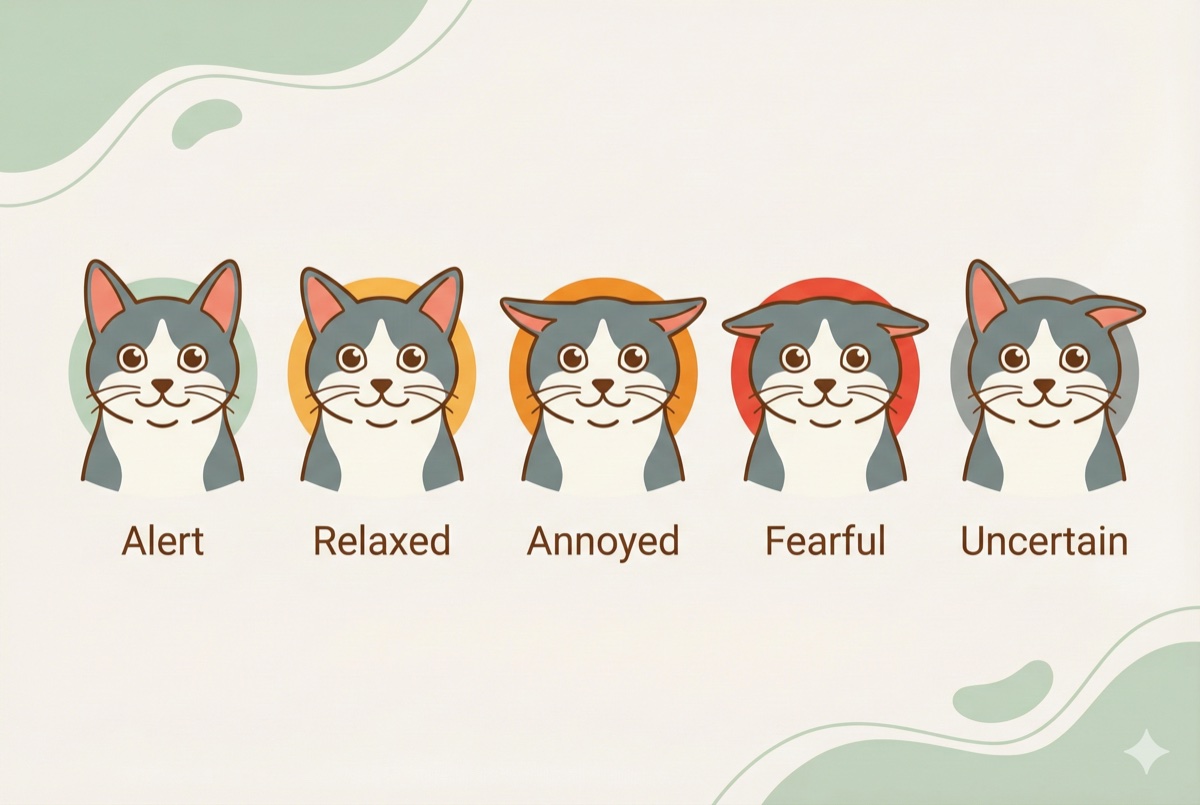
Ear positions and their emotional meanings
| Signal | What it tends to mean |
|---|---|
| Forward and upright | Alert, curious, focused on something in front of them. This is the relaxed-attentive default. |
| One or both ears rotated to the side | Listening to surrounding sound, processing information. Not a mood signal on its own. |
| Slightly back or down | Uncertain, ambivalent, mildly uncomfortable. Often a “thinking about whether to leave” signal. |
| Fully flattened backward against the head | Frightened, irritated, or defensive. Distance is asked for. |
| Flattened sideways, parallel to the ground (“airplane ears”) | Strong fear or defensive arousal. Often paired with hissing or a frozen posture. |
Whiskers
Whiskers are an underrated mood tell. Most owners never look at them, but they move with arousal and emotion just like ears.
Whiskers that fan forward and slightly splay outward usually mean interest or hunting focus. They might be reaching toward a toy, a sound, or a new object. Whiskers held neutrally to the sides indicate a relaxed cat. Whiskers pulled back, flattened against the cheeks, often signal fear, defensive aggression, or pain. If your cat’s whiskers are pinned back and they’re crouched and quiet, don’t assume they’re simply calm; that picture more likely means fear or discomfort.
Eyes and Pupils
Pupil size is mostly about light, but at any given light level, it also responds to arousal. Wide-open dilated pupils can accompany fear, excitement, predatory focus, or pain. Constricted pupils in normal light can come with offensive arousal or focused intensity. The pupil itself isn’t a mood reading; it’s an arousal volume knob. Pair it with the rest of the body.
A soft, half-closed gaze with slow blinks is different. Cats avoid hard staring with anyone they don’t fully trust because, in cat communication, a long stare is a threat. Closing the eyes around you means the cat feels safe enough to drop its guard. You can return a slow blink to send the same message back.
Body Posture
Posture pulls everything together. Look at how the body is loaded: is the weight up and forward (confident, ready to move), or low and tucked (compressing, ready to disappear)?
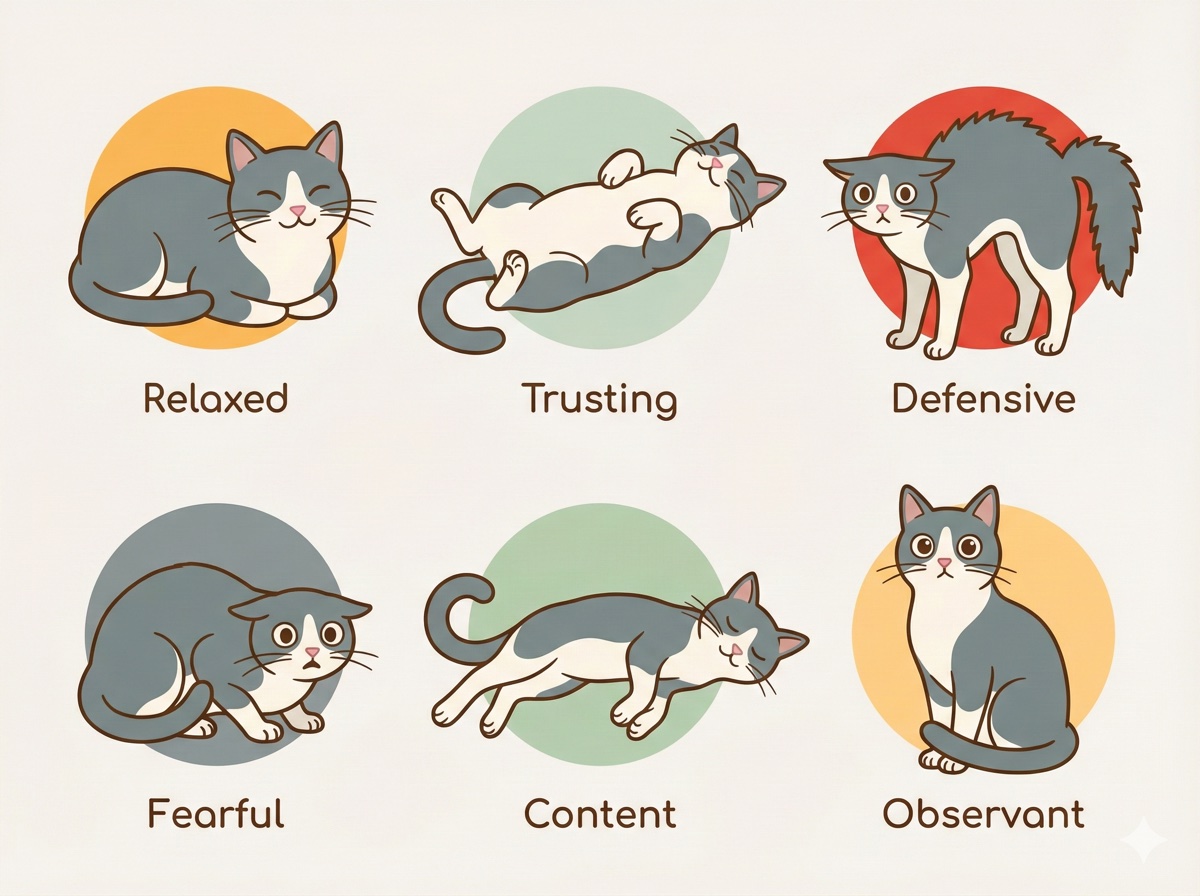
Common body postures and their meanings
| Posture | What it tends to mean |
|---|---|
| Loose body, sprawled on side or back, soft eyes, slow breathing | Genuinely relaxed. Belly exposure here is trust, but the rest of the body must also look soft. |
| Tail up, walking toward you, head slightly raised | A friendly approach. Often followed by head bunting or a flank rub. |
| Crouched with weight forward, pupils dilated, tail twitching, eyes locked on a target | Predatory focus or invited play. Context tells you which. |
| Crouched with weight back, tucked tightly, ears flat, whiskers pulled in | Fear, defensiveness, or pain. Do not approach to “comfort.” Give space. |
| Belly exposed during a tense encounter, claws ready | Defensive, not an invitation. All four paws are free for protection. |
| Hunched and still, withdrawing from interaction, hiding more than usual, eating less, over-grooming | Chronic stress or a medical issue. Often both. |
A common owner mistake: reading a belly-up posture as “rub me.” Sometimes it is, especially in a long, soft sprawl with a relaxed cat you know well. But during a tense moment, the belly comes out because all four sets of claws and teeth are now usable. Watch the rest of the body before you reach in.
Vocalizations
Sound is a useful extra layer. Pair it with body language and the read gets sharper, especially for moods that posture alone makes ambiguous.
The chirp and the trill are affiliative greetings, usually directed at a familiar human or kitten. A meow is almost entirely a human-directed signal. Adult cats rarely meow at each other. If your cat meows at you, that’s a learned communication, and each cat develops its own vocabulary. The meow your cat uses for “feed me now” works in your house, not in cat society at large.
Distance-increasing sounds are different. A hiss is a defensive “stay back” signal driven by fear, not aggression. A growl is a warning that escalation is close. Snarling, spitting, and yowling sit further along the same spectrum and signal severe distress, threat, or pain. A previously quiet cat who suddenly starts yowling, especially at night or in front of the litter box, deserves a vet check rather than a behavior assumption.
Purring is one of the most-misread sounds. It usually accompanies contentment, but cats also purr while in pain, while frightened, and while dying. Purr alone does not equal “happy.” Read it together with the body.
Scent Communication and Kneading
Cats are scent-driven, and a lot of what looks like affection is also scent-marking.
Head bunting, the gentle bump of a cat’s forehead and cheek against you, deposits pheromones from facial glands and marks you as part of the cat’s social group. Allorubbing, the longer flank rub along your legs or another cat’s body, does the same job. Both are real signs of social acceptance. The more relaxed your cat is during the contact, the stronger the signal.
Kneading, the rhythmic pushing of front paws against a soft surface, is a holdover from kittenhood, when kittens knead the mother’s belly to stimulate milk. In adult cats, it usually shows up alongside relaxation, sleepiness, and contact comfort. It is not a precise “I am happy right now” signal, but it does mean the cat feels safe enough to slip into kitten mode.
Spraying and middening, by contrast, are not affection. Vertical urine marking on a wall or furniture, or deposited stool left uncovered in a visible spot, is communication driven by stress, territorial conflict, or medical issues, especially in multi-cat homes or after a household change.
When Mood Reading Isn’t Enough
The most important thing to know about cat body language is that several “mood” signals are identical to pain signals. A cat that hides more, withdraws from interaction, holds its body tight and low, keeps its ears flat, narrows its eyes, and stops grooming or eating well is not necessarily anxious. It may be in real physical pain. Cats evolved to hide weakness so a predator does not pick them off, and they do it well enough to fool the people who feed them every day.
Sick or painful cats often present with:
- Flat or sideways ears for sustained periods, not just in response to a stimulus
- Whiskers pulled tight against the cheeks
- A crouched, hunched posture sustained for hours rather than minutes
- Reduced grooming, sometimes only in one body region
- Eating less, drinking less, or hiding food
- Reluctance to jump, climb, or be touched in usual ways
- New aggression when handled in a particular spot
If you see this picture and there’s no clear external stressor in the home, treat it as a vet visit rather than a behavior puzzle. Mood reading is most useful for normal, healthy cats. For an unwell cat, body language tells you to get help, not to interpret feelings.
How Furwise Can Help
Reading cat body language takes practice. Furwise can help you get better at it. Take a photo of your cat, and the app looks at their tail position, ear direction, whisker set, eye state, and overall posture to give you a read on how they’re probably feeling, along with suggestions for how to respond. For ambiguous postures that could indicate stress or pain, the app flags them for closer attention rather than guessing at a mood.
Putting It All Together
The fastest way to misread a cat is to read one signal with no context. A cat with ears slightly back at the vet is not the same cat with ears slightly back on your sofa while you scratch their chin. Scan the whole cat, tail and ears and whiskers and eyes and posture and sound, and then ask what the situation is doing to them. Ask what they’re asking for: more contact, less contact, space, food, play, rest.
The more time you spend watching, the better the read gets, and the more your cat learns that you’ll listen when they tell you something.
Frequently Asked Questions
What does it mean when my cat wags its tail? Unlike dogs, a wagging or swishing tail on a cat usually means agitation or overstimulation. The faster the swish, the more aroused they are. A slow, lazy swish often means quiet focus. If the tail starts lashing while you’re petting them, stop. Continuing past that point is how owners get bitten or scratched.
Why does my cat suddenly bite me while I’m petting them? This is called petting-induced overstimulation, and it’s one of the most common reasons cats redirect onto a hand. Most cats give clear warning first: skin rippling along the back, tail thumping, ear flicks, a small head turn toward the hand, dilated pupils. Owners often miss these because the cat looks “calm.” When you see any of these signs, stop the petting before the cat has to escalate. Keep sessions short, watch the body, and avoid long belly or base-of-tail strokes unless you know your individual cat enjoys them.
Why does my cat slow blink at me? A slow blink is an affiliative, non-threatening signal. Because direct staring is threatening in cat language, a deliberate eye closure says “I feel safe with you.” Slow blink back, and your cat is more likely to return one. Even unfamiliar cats approach humans who slow-blink at them more readily, so it’s worth doing.
What does it mean when my cat’s tail vibrates or quivers straight up? A tail held upright and quivering rapidly is an excited affiliative greeting, often shown when a cat is happy to see you or another cat they like. It can look unsettling because it resembles urine-spraying, but in most cases it’s an enthusiastic hello with no spray attached. If you do see actual marking on a vertical surface, that’s a separate issue worth investigating.
How can I tell if my cat is happy? A happy cat is usually loose-bodied, breathes slowly, holds its tail up or in a relaxed shape, has soft eyes, and approaches you on its own terms. They may purr, knead, head-bunt, or settle near you. Eating well, drinking well, grooming normally, using the litter box predictably, and engaging in play are all background signals of a good baseline. A single behavior never confirms it, but the picture together usually does.
Hissing, growling, yowling: what’s the difference? A hiss is a defensive “back off” signal, often the cat’s first warning. It is fear-driven, not malicious. A growl is a stronger warning that the cat is willing to escalate if the threat doesn’t retreat. Snarling and spitting are intensification of the same defensive pattern. Yowling is a longer, more open-mouthed vocalization that can signal severe distress, territorial conflict, mating behavior, cognitive changes in older cats, or pain. None of these should be punished. They are communication.
What do airplane ears mean on a cat? When a cat’s ears flatten sideways, parallel to the ground, it’s called airplane ears. This usually means the cat is scared, defensive, or in pain. Give them space, remove or reduce whatever is causing the stress if you can identify it, and if it doesn’t resolve quickly or seems unprovoked, treat it as a possible medical issue rather than a mood swing.
Is my cat’s belly an invitation to rub it? Sometimes, but not always. A loose, sprawled belly in a familiar, safe context can mean the cat is happy to be touched there. The same exposed belly during a tense moment, with the body coiled and the paws ready, is defensive: all four sets of claws are now available. Watch the rest of the body before you commit your hand.
References
- Bradshaw, J. W. S., & Cameron-Beaumont, C. (2000). The signalling repertoire of the domestic cat and its undomesticated relatives. In The Domestic Cat: The Biology of its Behaviour (2nd ed., pp. 67–93). Cambridge University Press.
- Cafazzo, S., & Natoli, E. (2009). The social function of tail up in the domestic cat (Felis silvestris catus). Behavioural Processes, 80(1), 60–66. DOI
- Crowell-Davis, S. L., Curtis, T. M., & Knowles, R. J. (2004). Social organization in the cat: A modern understanding. Journal of Feline Medicine and Surgery, 6(1), 19–28. DOI
- Evangelista, M. C., et al. (2019). Facial expressions of pain in cats: The development and validation of a Feline Grimace Scale. Scientific Reports, 9, 19128. DOI
- Galvan, M., & Vonk, J. (2021). Heads and tails: An analysis of visual signals in cats, Felis catus. Animals, 11(9), 2752. DOI
- Humphrey, T., Proops, L., Forman, J., Spooner, R., & McComb, K. (2020). The role of cat eye narrowing movements in cat–human communication. Scientific Reports, 10, 16503. DOI
- Rodan, I., et al. (2022). 2022 AAFP/ISFM Cat Friendly Veterinary Interaction Guidelines: Approach, handling and interactions. Journal of Feline Medicine and Surgery, 24(11), 1093–1132. DOI
- Ellis, S. L. H., et al. (2013). AAFP and ISFM Feline Environmental Needs Guidelines. Journal of Feline Medicine and Surgery, 15(3), 219–230. DOI
- International Cat Care. (2023). Cat Body Language. icatcare.org