

Vaccines protect your cat from diseases that have no cure. This guide clarifies vaccine types, schedules, and the small but real risk of injection-site sarcomas so owners can make informed decisions.
Why vaccines matter
Cats can catch several serious viral and bacterial infections, some without effective treatment. Vaccines train your cat’s immune system to recognize and clear these pathogens before they cause illness.
Without vaccination:
- Feline panleukopenia has a very high mortality rate in kittens
- Rabies is 100% fatal once symptoms appear, and can spread to humans
- Feline leukemia virus weakens the immune system over months to years and is linked to lymphoma
Core vs non-core vaccines
Veterinary guidelines from AAHA/AAFP and WSAVA divide cat vaccines into two categories:
Core vaccines are recommended for every cat, regardless of lifestyle:
- FVRCP (Feline Viral Rhinotracheitis, Calicivirus, Panleukopenia)
- Rabies
- FeLV for kittens under 1 year old
Non-core vaccines depend on risk:
- FeLV for adult cats with outdoor access or in multi-cat households
- Chlamydia felis
- Bordetella bronchiseptica, mainly relevant for cats entering shelters, catteries, or boarding facilities
About the FIV and FIP vaccines
The FIV vaccine (Fel-O-Vax FIV) was withdrawn from the US and Canadian markets between 2015 and 2017 and is no longer sold there. It remains available in Japan, Australia, and New Zealand. The FIP vaccine exists but is not recommended by AAHA, AAFP, or WSAVA because of limited evidence for protection. FIP itself is now treatable in many cases with the antiviral GS-441524, but that doesn’t change the vaccine’s status.
Understanding each vaccine
FVRCP (the “3-in-1” vaccine)
This combination vaccine protects against three diseases:
| Disease | What it does | Why it matters |
|---|---|---|
| Feline panleukopenia (FPV) | Attacks rapidly dividing cells | Highly contagious, often fatal in kittens |
| Feline herpesvirus (FHV-1) | Causes upper respiratory infection | Lifelong carrier status, stress triggers flare-ups |
| Feline calicivirus (FCV) | Causes respiratory and oral disease | Multiple strains exist, can cause chronic issues |
In US clinics this is sometimes labeled “feline distemper.” Same vaccine, older name.
Rabies
Rabies is a fatal viral disease of the nervous system, transmissible to humans. Most US states and many countries legally require rabies vaccination for cats, even indoor-only ones. Where a state has no statewide rule, city or county ordinances often set one anyway, so check local law rather than assuming your cat is exempt.
Feline leukemia virus (FeLV)
FeLV spreads through prolonged close contact: mutual grooming, shared bowls, bite wounds. Kittens are far more susceptible than adults, which is why FeLV is considered core for cats under one year old.
Test before you vaccinate. WSAVA 2024 guidelines specify that only FeLV-negative cats should be vaccinated. The vaccine offers no benefit to a cat that is already FeLV-positive, and the test is fast and cheap. Most clinics combine the FeLV / FIV test in one visit.
Kitten vaccination schedule
Kittens receive maternal antibodies through their mother’s milk, but this protection fades over weeks to months, and the timing varies between kittens. That’s why kittens need multiple doses spaced out, rather than a single shot. (For the broader first-month-with-a-kitten context, see Bringing Home a Kitten.)
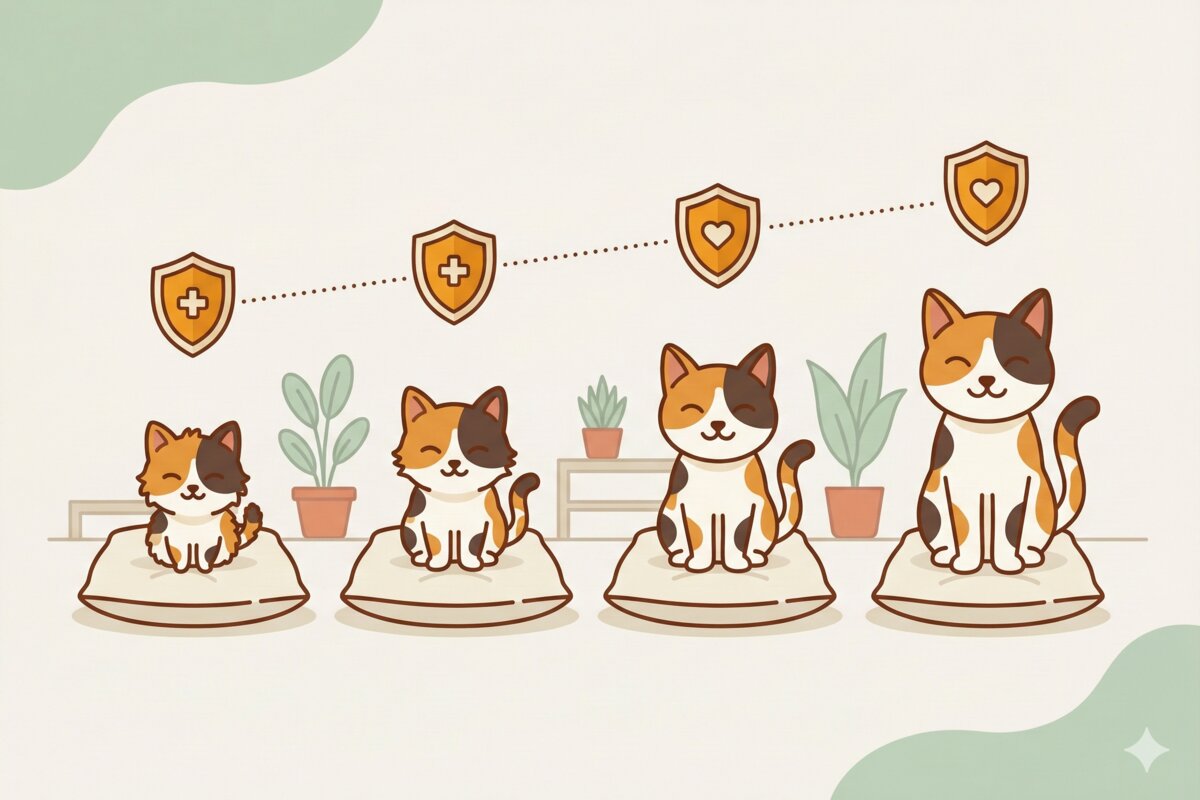
Kitten vaccination milestones from 6 weeks to 6 months
| Age | Vaccines |
|---|---|
| 6–8 weeks | FVRCP #1 |
| 8 weeks+ | FeLV #1 (if indicated) |
| 10–12 weeks | FVRCP #2, FeLV #2 |
| 14–16 weeks | FVRCP #3, Rabies |
| 6 months | FVRCP booster (WSAVA 2024) |
The final FVRCP dose should be given at 16 weeks or later so maternal antibodies have faded enough for the kitten’s immune system to respond. In high-risk environments (shelters, multi-cat households with FPV history), WSAVA 2024 extends the final dose to 20 weeks. The 6-month booster catches kittens whose maternal antibodies blocked the earlier shots.
Adult cat booster schedule
After a complete kitten series, healthy low-risk adults need periodic boosters:
| Vaccine | Booster frequency |
|---|---|
| FVRCP | Every 3 years (often longer with titer testing) |
| Rabies | Every 1 or 3 years, depending on local law and product label |
| FeLV | Every 2–3 years, only if at risk |
Indoor-only cats with no exposure to other cats may not need FeLV boosters after the first year. For FVRCP, immunity to panleukopenia can last 7+ years, so some vets use titer testing (a blood test for antibody levels) to decide if another booster is needed. Ask if it’s offered.
Adopting an adult with unknown vaccine history
If you adopt an adult cat with no records, WSAVA 2024 recommends:
- FVRCP: two doses of modified-live vaccine 2 to 4 weeks apart, since herpesvirus and calicivirus protection is less robust from a single dose
- Rabies: one dose (local law sets the frequency from there)
- FeLV: test first, then vaccinate if the cat is negative and at risk
Don’t skip the second FVRCP just because the cat seems healthy. Many shelter cats arrive incubating herpesvirus.
What it costs
US clinic prices vary widely. Typical full-service practice ranges in 2025–2026:
| Item | Range |
|---|---|
| Office / exam fee | $50–$100 |
| FVRCP | $25–$50 |
| Rabies (adjuvanted) | $25–$50 |
| Rabies (PureVax non-adjuvanted) | $36–$70+ |
| FeLV | $25–$50 |
| FeLV/FIV combo test | $40–$70 |
Low-cost vaccine clinics and shelter-affiliated programs run shots for $15–$25 each without an exam, which is reasonable for healthy adults but skips the physical that catches early disease.
Injection sites and FISS
Adjuvants are additives in some vaccines that boost the immune response. The trade-off is more inflammation at the injection site. In a small number of cats, that chronic inflammation eventually triggers abnormal cell growth and a malignant tumor called feline injection-site sarcoma (FISS). It’s rare. UK and US clinical estimates put incidence in the range of 1 per 5,000 to 1 per 12,500 vaccinations, with figures varying by methodology and setting.
Before the 1990s, vets gave most vaccines between the shoulder blades. When tumors started showing up there, the problem became clear: a sarcoma over the spine is nearly impossible to remove with clean surgical margins. So the protocol changed. Vaccines now go in the limbs, as far down the leg as possible. If a tumor develops, the leg can be amputated, and the prognosis is far better than with a spinal tumor.
Which vaccine goes where
AAFP standardized injection sites so a vet can trace which vaccine likely caused a problem if a tumor appears:
| Vaccine | Injection site |
|---|---|
| Rabies | Right hind leg, below the knee |
| FeLV | Left hind leg, below the knee |
| FVRCP | Right front leg |
Current AAHA/AAFP and WSAVA guidelines advise against interscapular (scruff) injections for this reason.
What if my vet used the scruff? If a vaccine was given between the shoulder blades, don’t panic. The risk of FISS is still very low. For future visits, you can mention the AAFP guidelines that recommend leg injections. For now, be extra vigilant in monitoring the injection site using the 3-2-1 rule. The most important thing is that your cat is protected from disease.
Non-adjuvanted vaccines (PureVax)
Because adjuvants drive the inflammation behind FISS, non-adjuvanted vaccines exist. PureVax by Boehringer Ingelheim uses recombinant virus technology instead of adjuvants. Both 1-year and 3-year labeled PureVax rabies products are now available in the US. For the 3-year product, the protocol is an initial dose, a booster one year later, and then boosters every 3 years after that.
PureVax costs more (often $36–$70+ for the 3-year vs $25–$50 for adjuvanted rabies). AAFP recommends non-adjuvanted vaccines when available, but an adjuvanted vaccine in the correct leg is still safe.
The 3-2-1 rule for monitoring
A small lump at the injection site is normal and usually goes away within 2 to 4 weeks. See your vet if:
- The lump is still there 3 months after the shot
- It’s larger than 2 cm
- It’s still growing 1 month after vaccination
This is the AAFP’s 3-2-1 rule. A mass that meets any of these criteria should be biopsied early rather than watched indefinitely. FISS responds best to wide surgical excision before it becomes large.
Post-vaccination care
Most cats have no reaction at all. Mild side effects are common and usually resolve within 24 to 48 hours:
- Slight lethargy
- Reduced appetite
- Mild fever
- Small, temporary swelling at the injection site (monitor with the 3-2-1 rule above)
Immediate and delayed allergic reactions
Most severe allergic reactions (Type I hypersensitivity) happen quickly, typically within the first 30 to 60 minutes after vaccination. But reactions can also be delayed by several hours, so keep watching for the rest of the day. Signs to watch for:
- Vomiting or diarrhea
- Facial or eyelid swelling
- Hives, especially around the muzzle
- Difficulty breathing, wheezing
- Collapse, weakness
Facial swelling, breathing trouble, or collapse is a same-day emergency at any point. Don’t wait it out. Call the vaccinating clinic first so they can prepare for an urgent visit.
If your cat has had a prior vaccine reaction, tell the clinic before the shot. Ask whether they want to observe your cat for 30 to 60 minutes after vaccination rather than sending you straight home, and whether pre-medication with an antihistamine is appropriate.
Senior cats: when to consider stopping
There isn’t a hard cutoff age for vaccinating cats. Most healthy seniors continue on the standard schedule. But for an indoor-only senior (11+) with no exposure to other cats, completed boosters, and chronic illness like kidney disease or hyperthyroidism, titer testing is worth raising with your vet. A blood test can confirm whether FPV antibodies are still protective and let you skip a booster that may not add benefit. Rabies vaccination is usually still legally required regardless of age.
Keeping track without spreadsheets
Vaccine schedules get messy fast, especially with multiple cats on different timelines and the occasional missed booster. Furwise is building vaccine-reminder features that log each cat’s history and alert you before boosters are due, so the schedule doesn’t depend on memory.
Frequently Asked Questions
Do indoor cats need vaccines? Yes. Core vaccines (FVRCP and rabies) are recommended for every cat, indoor-only included. Panleukopenia virus survives on surfaces and can be tracked into the home on shoes or clothing. Rabies vaccination is also legally required in many areas regardless of lifestyle.
How often do adult cats need booster shots? After the kitten series, FVRCP is typically every 3 years (longer is sometimes appropriate with titer testing). Rabies depends on local law and product, typically every 1 or 3 years. FeLV boosters are every 2 to 3 years and only needed for cats at risk through outdoor access or multi-cat households.
How much do cat vaccinations cost in the US? Expect $25 to $50 per shot at a full-service clinic, plus a $50 to $100 office or exam fee per visit. PureVax non-adjuvanted rabies runs $36 to $70 or more. Low-cost vaccine clinics offer $15 to $25 per shot without an exam, which is fine for healthy adults but skips the physical.
What if my cat missed a booster? Missing by a few weeks or even months usually doesn’t mean restarting. For FVRCP, if your cat is more than a year overdue, your vet may give two doses 2 to 4 weeks apart to be safe. Rabies depends on the gap and your state’s law. Some states require restarting if it has lapsed.
My cat had a reaction last time, can we still vaccinate? Often yes, but the protocol changes. Tell the clinic about the prior reaction. They may pre-medicate with an antihistamine, split a combination vaccine into separate visits, switch to a non-adjuvanted product, or observe your cat for 30 to 60 minutes after the shot. Severe reactions sometimes mean skipping the non-essential ones and keeping only legally required rabies.
Is the FIV vaccine still available? Not in the US or Canada. The Fel-O-Vax FIV vaccine was withdrawn between 2015 and 2017. It remains available in Japan, Australia, and New Zealand. In the US and Canada the current standard is FIV testing rather than vaccination, plus keeping FIV-positive cats from fighting with FIV-negative cats.
What is the difference between adjuvanted and non-adjuvanted vaccines? Adjuvants are additives that boost immune response. They’re effective but drive more inflammation at the injection site, which is the main risk factor for FISS. Non-adjuvanted vaccines like PureVax use recombinant technology instead, with a smaller (though not zero) inflammation risk. They cost more.
References
- Stone AE, Brummet GO, Carozza EM, Kass PH, Petersen EP, Sykes J, Westman ME. (2020). 2020 AAHA/AAFP Feline Vaccination Guidelines. Journal of Feline Medicine and Surgery, 22(9), 813–830.
- WSAVA Vaccination Guidelines Group. (2024). Guidelines for the Vaccination of Dogs and Cats. World Small Animal Veterinary Association.
- Hartmann K, Möstl K, Lloret A, Thiry E, Addie DD, et al. (2015). Vaccination of immunocompromised cats. Journal of Feline Medicine and Surgery, 17(7), 581–600.
- Hartmann K. (2012). Clinical aspects of feline retroviruses: a review. Viruses, 4(11), 2684–2710.
- American Association of Feline Practitioners. (2020). AAHA/AAFP Feline Vaccination Guidelines. catvets.com.
- Cornell Feline Health Center. (2023). Feline Vaccines: Benefits and Risks. Cornell University.