
The moment that melts you, with a cat like this, is the first time she crosses the room to you on her own, settles in beside you, or falls asleep against your leg. Given the right approach and enough time, most shy cats get there. This guide walks you through it step by step, until being near you feels safe to her, and maybe even something she likes.
Why is my cat so afraid of people?
You have probably seen the kind of cat who rolls over for a belly rub the moment a guest walks in, utterly unbothered. Then there’s yours, who bolts the second you come near. Same species, wildly different, and whether a cat warms up to people comes down largely to temperament and past experience, in more than one way.
Some cats are undersocialized. They simply did not meet enough calm, friendly humans during the narrow window in early kittenhood when cats learn that people are part of normal life, so humans register as large unpredictable objects rather than a source of good things. Some cats are temperamentally fearful, born more cautious than average, the way some people are; they can warm up, but they spook easily and recover slowly. And some are basically sound but overwhelmed by a recent move, and just need time to reset.
First, make sure it isn’t pain
Sometimes a cat keeps her distance because something hurts. This matters most when the behavior is new. A cat who used to tolerate handling and now won’t be touched, who suddenly hides, who flinches or swats when you stroke a particular spot, may be telling you something is painful. Cats are built to conceal pain, and withdrawal is one of the few signals that leak through. This kind of physical discomfort is common, and it is the easiest thing to mistake for a mood.
The quick filter: a cat who has been consistently shy since you got her, with no other symptoms, is probably working through fear, and the rest of this guide applies. A cat whose avoidance appeared or worsened suddenly, especially alongside changes in appetite, litter box habits, grooming, or a specific flinch when touched, should see a vet before you assume it is behavioral. When you are not sure, the signs of pain and the catalog of stress behaviors are worth a closer look, but the safe default is a check-up first.
The right environment does half the work
The most effective thing you have is the environment, more than any technique. A cat who feels safe and in control of her own space spends far less energy being afraid, and that leftover energy is what lets her start getting curious about you.
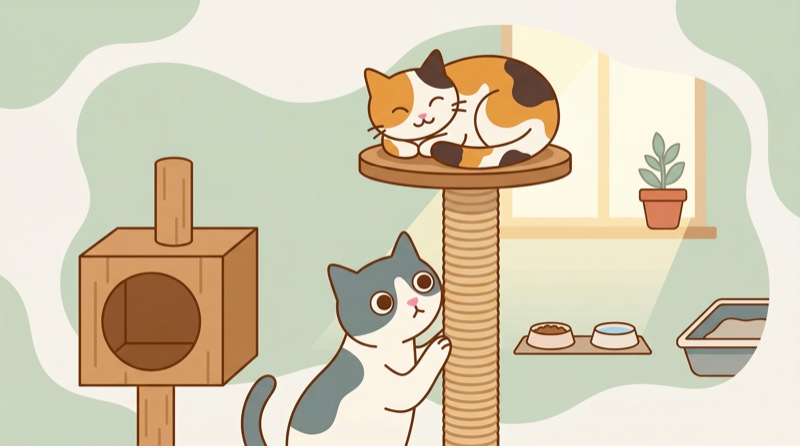
Start with hiding places, and resist the urge to take them away. A frightened cat who can reliably get out of sight is calmer, not more withdrawn, than one with nowhere to retreat. Give her options at different heights: a covered bed on the floor, a cardboard box on its side, and somewhere up high, because elevation lets a cat watch the room from a position that feels defensible. The cat who can always escape is the cat who eventually decides she doesn’t need to.
Then make the place predictable. Fearful cats relax into routine the way anxious people do; meals at roughly the same times, the same rhythm to your day, furniture that mostly stays put. Scent is a big part of this and easy to overlook, since cats read a home largely through smell. Leave a worn t-shirt near her safe spot so your scent becomes part of the furniture rather than a thing that arrives suddenly. Keep your own movements low and slow near her, no looming over the top of her, no reaching down from above, which to a small prey animal feels the way a swooping hawk would to you.
Your eyes and voice are part of the environment too. A long, hard stare is threatening in cat language, so when you catch her watching you, look slightly away, and if you want to answer, give a slow blink, letting your eyes narrow and close for a beat. It is not a magic password, just a low-pressure way of signaling you mean no harm. In one study, cats were more likely to slow-blink back, and to approach a stranger, after a person slow-blinked at them, which makes it about as close to a friendly word as we have. A steady, quiet voice used consistently, even just narrating what you’re doing, gives her one more familiar, predictable signal to anchor to.
The counterintuitive part is that the best thing you can often do is less. The person who sits on the floor reading a book, ignoring the cat entirely, is far more approachable than the person crouched and staring and reaching. Be present, be boring, and let her close the distance. Curiosity tends to win once fear has somewhere to rest.
Food and play build trust, slowly
A safe home gets a cat to stop being on guard all the time. Turning that into trust comes down to one repeated message: good things happen when you’re around. You pair your presence with things she already wants, and over many small repetitions you become, in her eyes, someone safe who reliably brings good things. And your company may be worth more to her than you’d think. When researchers gave cats a free choice between food, toys, scent, and time with a person, social interaction was the top preference for the largest share of them, ahead of food. She wants you, in other words. She just can’t take you up on it yet.
Food is the most reliable starting currency because it is concrete and the cat has to eat anyway. If she will only eat when you leave, that’s your baseline, not a defeat. Put the food down and withdraw to a distance where she’ll eat, then over days shrink that distance a few inches at a time. Sit nearby while she eats without looking at her. Hand-feeding a treat, once she’s ready, makes you personally the source rather than the room. The whole game is moving in increments small enough that she barely notices the threshold moving.
Play does something food can’t, it lets her interact with you while keeping a buffer, because a wand toy is a few feet of safe distance with your hand at the far end. A fearful cat who would never approach your fingers will often chase a feather she can “catch” without ever touching you, and the act of hunting pulls a cat out of a defensive crouch and into something that looks a lot like confidence. It is also one of the few ways to build positive association with movement near her, since the good thing is moving and she is choosing to come closer to it.
Expect this to be uneven. A cat who let you stroke her on Tuesday may want nothing to do with you on Wednesday, and a vet visit, a houseguest, or a thunderstorm can undo what feels like weeks of progress in an afternoon. This is normal and not a sign you did something wrong. When it happens, drop back to the last distance where she was comfortable and rebuild from there. Trust with a fearful cat is rarely a straight line; it is a series of advances and small retreats that, over months, trend the right way.
Learn to read consent before you touch
The most common way well-meaning people set themselves back is touching a cat who is tolerating it rather than enjoying it. There is a real difference between a cat who approaches you and a cat who is frozen and letting it happen because the alternative feels worse, and a cat pushed past tolerating is a cat who learns that hands are unpredictable.
The rule that prevents most of this is simple: let her initiate, and let her choose to continue. When she comes to you, offer a finger at her nose height and let her sniff and rub against it rather than reaching for her. A cat who bunts her cheek into your hand is consenting; a cat who leans away, goes still, or gives a slow tail-twitch is not. Keep the first contact to the places cats generally accept, the cheeks, the chin, the base of the ears, and stay away from the belly, the tail, and the back legs until you’re well established. Keep sessions short, and stop while she’s still enjoying it rather than waiting for her to tell you she’s had enough.
That last signal is worth knowing, because the “petting then suddenly biting” cat is almost always a cat whose quieter requests to stop got missed. A tail that starts lashing, ears rotating back or flattening, skin twitching along the back, a sudden stillness, these usually come first, and the cats that seem to “bite with no warning” are mostly cats whose warning was too quiet to catch. If you want to get fluent in the smaller tells, the full guide to feline body language is the place, but the one-line version is this: when in doubt, take your hand away. Ending an interaction on her terms is itself a trust deposit, because it teaches her that being near you never traps her.
When to get professional help
Most shy cats improve with a safe home and a patient human, over weeks to months. But some don’t. If she stays extremely fearful, keeps getting worse rather than better over a couple of months, or the whole environment becomes a stressor and she only eases in her safest corner, it’s worth talking to a professional. The same goes if the fear comes with physical red flags: not eating, not using the litter box, grooming herself raw, or fear that has tipped into real aggression that makes daily care unsafe. None of that means you’ve failed. It means the problem is bigger than patience alone.
Start with your vet, who can rule out medical contributors and, where warranted, refer you to a veterinary behaviorist, the specialists who handle the hard cases. For some cats, medication can lower the baseline fear enough that the trust-building finally gets traction, the way it can for an anxious person starting therapy. Whether that fits a given cat, and what it would involve, is a judgment for your vet to make case by case, not something to decide from an article.
It all comes back to the same thing. You can’t talk a frightened cat into trusting you, and you can’t rush her. What you can do is make being near you safe, predictable, and quietly rewarding, and then wait, longer than feels reasonable, until she decides on her own that the offer is real. Most cats, given that, soften a great deal, on a clock that is entirely their own. And even if she never becomes a lap cat, a cat who can simply live at ease with you is already a lot.
Frequently Asked Questions
How long does it take for a scared cat to trust you? It varies enormously with where the cat is starting from. A basically sound cat overwhelmed by a recent move may relax in a few weeks. A temperamentally fearful cat usually takes a few months. A semi-feral adult raised with little human contact often needs many months, and some never fully enjoy being handled even after they settle into sharing a home calmly. The honest measure of progress is not affection but a steady reduction in fear: eating with you in the room, sleeping in the open, choosing to come closer.
Should I let my shy cat hide, or coax her out? Let her hide. A frightened cat who can reliably retreat is calmer than one who can’t, and removing hiding spots or pulling her out makes things worse, not better. The goal is to make the rest of the room safe enough that she chooses to come out on her own. Sit nearby, ignore her, and let good things like food and play happen at a distance she can tolerate. Paradoxically, a cat who is sure she can get away whenever she wants is the one who, over time, stops needing to.
Why does my cat only trust one person? This is common and not a fixed trait. It usually means trust has formed but hasn’t generalized yet: the cat learned that one specific person is safe before learning that humans in general can be. The other people in the household can build the same trust by following the same approach, letting the cat initiate, pairing themselves with food and play, and never forcing contact. It simply tends to start later and move at its own pace for each person.
Can a semi-feral adult cat ever become a lap cat? Some do, many don’t, and both outcomes are fine. A semi-feral adult who learns to live calmly indoors, eat in your presence, and sleep nearby has made a huge change even if she never wants to be held. Set the goal as less fear rather than maximum cuddliness. Pushing for lap-cat closeness a cat isn’t built for usually backfires by making your hands and proximity feel threatening, which is the opposite of what you want.
Is it better to use treats or to just keep handling a shy cat until she gets used to it? Treats and choice, not forced handling. Repeatedly handling a cat who is tolerating rather than enjoying it teaches her that hands are unpredictable and sets trust back. Pairing your presence with food and play, and letting her decide when to approach and when contact ends, builds a positive association at a pace she controls. Forcing closeness, sometimes called flooding, tends to backfire, which is why behavior plans lean on gradual exposure and good associations instead.
References
- Ellis, S. L. H., Rodan, I., Carney, H. C., Heath, S., Rochlitz, I., Shearburn, L. D., Sundahl, E., & Westropp, J. L. (2013). AAFP and ISFM feline environmental needs guidelines. Journal of Feline Medicine and Surgery, 15(3), 219-230.
- Casey, R. A., & Bradshaw, J. W. S. (2008). The effects of additional socialisation for kittens in a rescue centre on their behaviour and suitability as a pet. Applied Animal Behaviour Science, 114(1-2), 196-205.
- Vitale Shreve, K. R., Mehrkam, L. R., & Udell, M. A. R. (2017). Social interaction, food, scent or toys? A formal assessment of domestic pet cat (Felis silvestris catus) preferences. Behavioural Processes, 141, 322-328.
- Vitale, K. R., Behnke, A. C., & Udell, M. A. R. (2019). Attachment bonds between domestic cats and humans. Current Biology, 29(18), R864-R865.
- Humphrey, T., Proops, L., Forman, J., Spooner, R., & McComb, K. (2020). The role of cat eye narrowing movements in cat-human communication. Scientific Reports, 10, 16503.
- Cornell University College of Veterinary Medicine. Feline Behavior Problems. Cornell Feline Health Center
- Ohio State University Veterinary Medical Center. Indoor Pet Initiative. Indoor Pet Initiative