
Cats hide when they’re unwell, but also when they’re fine. They over-groom when they’re stressed, but also when they have fleas. They stop using the litter box when something’s wrong, but figuring out which kind of “wrong” can take real detective work. This guide is about one of the most overlooked causes behind all three: stress, and how the environment around your cat shapes it.
The signs that usually get missed
Hiding for an afternoon after the vacuum cleaner isn’t stress in the clinical sense. The signs that matter are the ones that stick around, or that show up after something changed at home.
Hiding that doesn’t resolve
All cats hide sometimes. The pattern worth paying attention to is a cat that used to greet you at the door and now spends whole days under the bed, or a cat that stops using rooms it used to own. Hiding in new spots, especially dark low-to-the-ground places, is how cats ask for a break from something they can’t turn off themselves.
Over-grooming or hair loss
Cats groom to calm themselves, the way some people bite their nails. When it tips over into bald patches, usually on the belly, inner thighs, or forearms because those are the reachable spots, veterinarians sometimes call it psychogenic alopecia. But that label should come last, not first. Before anyone calls it stress, two other causes need to be ruled out. The first is skin problems (fleas, allergies, parasites), which produce the exact same pattern. The second is localized pain, because cats will often groom directly over a spot that hurts. A bald patch on the lower belly is a recognized clinical sign of bladder pain from feline idiopathic cystitis, and grooming concentrated over a specific joint can point to arthritis. When the skin is healthy, pain has been ruled out, and the patches keep expanding, stress belongs on the shortlist (Amat, Camps, & Manteca, 2016).
Peeing or pooping outside the litter box
This is the one owners often take personally, but it almost never is. Cats eliminating outside the box are usually telling you one of three things: the box itself is wrong (dirty, too small, wrong location, wrong litter), there’s a medical problem (urinary, GI, arthritis), or they’re stressed. Stress can even cause a medical problem directly. Feline idiopathic cystitis, a bladder condition that causes straining and bloody urine, is strongly linked to stress and environmental pressure, and the treatment is often environmental rather than medicinal (Buffington, 2011).
Aggression or flinchy reactivity
A cat that suddenly hisses at a housemate, swats when touched, or starts reacting to noises it used to ignore isn’t being “mean.” That’s a nervous system stuck in alert mode. If the shift is recent, something in the environment changed.
Eating and sleeping changes
Eating more or less, sleeping in unusual places, or a disrupted sleep pattern can all be early signals. They’re subtle enough that owners usually don’t catch them until something more obvious shows up. For what counts as normal sleep and when changes suggest medical vs emotional causes, see the cat sleep guide.
Compulsive behaviors
Pacing, repetitive tail-chasing, wool-sucking, and excessive vocalization (especially at night) can all be stress-driven once medical causes are excluded.
The cat that looks “too chill”
This one gets missed the most. Some stressed cats don’t act out. They shut down. They stop exploring, stop initiating play, spend most of the day lying still in a neutral spot, and tolerate handling that other cats would refuse. Owners often read this as “she’s just really laid-back” when it’s actually closer to learned helplessness: a state where the cat has stopped trying to influence its environment because nothing it does seems to change anything (Barrios et al., 2025). A previously active cat that became “calm” after a household change isn’t always a success story.
What usually triggered it
Stress in cats almost always traces back to something the cat can’t control. The common triggers:
- A home change: moving, new furniture, renovation, a rearranged room
- A new resident: a new baby, a partner moving in, a second cat, a dog, or a long-staying relative
- A loss: a family member leaving, a companion cat dying, a shift in the owner’s schedule
- A multi-cat conflict you might not have noticed: cats are quiet about conflict. Staring, blocking doorways, and controlling access to the food bowl count as conflict even when there’s no fighting
- Construction, ongoing loud noise, or an unusually busy household
- Not enough control over their own space: no high perches, no quiet retreat, no way to avoid something they find threatening
None of these are inherently bad, but they all remove something from the cat’s sense of predictability. Cats run on predictability.
One special case worth flagging: if the stressed cat is itself the new arrival, not an existing cat reacting to one, you’re in a different situation. Hiding, reduced eating, and litter box hesitation in the first few weeks with an adopted cat are expected adjustment behaviors, not clinical stress signs. The things to watch for there are the reactions that don’t start to resolve once the new environment becomes familiar.
The real fix isn’t a calming treat
You can buy pheromone diffusers, calming supplements, and prescription anti-anxiety medication, and sometimes those help. But the research on feline stress keeps pointing at one thing underneath all of them: the environment the cat actually lives in. The American Association of Feline Practitioners and the International Society of Feline Medicine published a joint document called the AAFP and ISFM Feline Environmental Needs Guidelines that lays out what a cat needs from its home to feel okay. They call them the five pillars (Ellis et al., 2013).
If you do nothing else from this article, do these five things.
Pillar 1: A safe space
Every cat needs a place it can retreat to where nothing follows. Not a corner where the dog walks past. Not a bed in the middle of the living room. A genuine hideaway where the cat controls entry and exit.
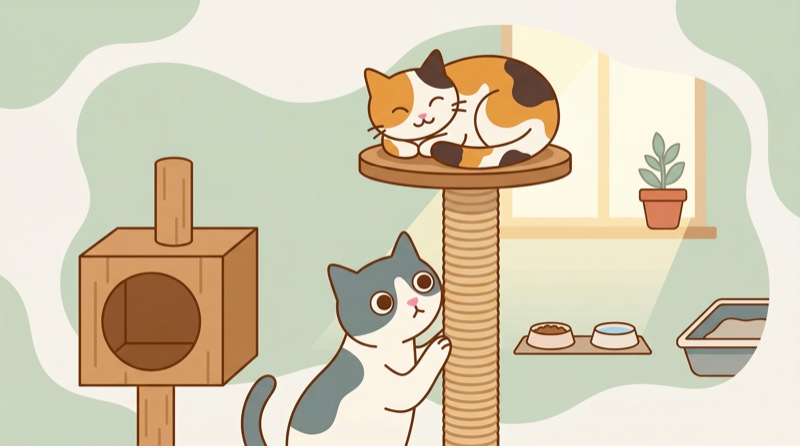
In practice, that often means a covered bed on a high shelf, a cardboard box tipped on its side, an open closet, or a cat tree with a cubby at the top. Height matters, because being up high lets a cat see what’s coming without being cornered. Multiple options matter more than one perfect spot, because the right retreat changes with mood and time of day.
The rule: if the cat is using the hiding spot, do not disturb. That’s the whole point of it existing.
Pillar 2: Multiple, separated resources
Food. Water. Litter boxes. Scratching posts. Resting spots. Each of these counts as a resource, and cats need them placed so that reaching one never requires crossing another cat’s territory or being cornered.
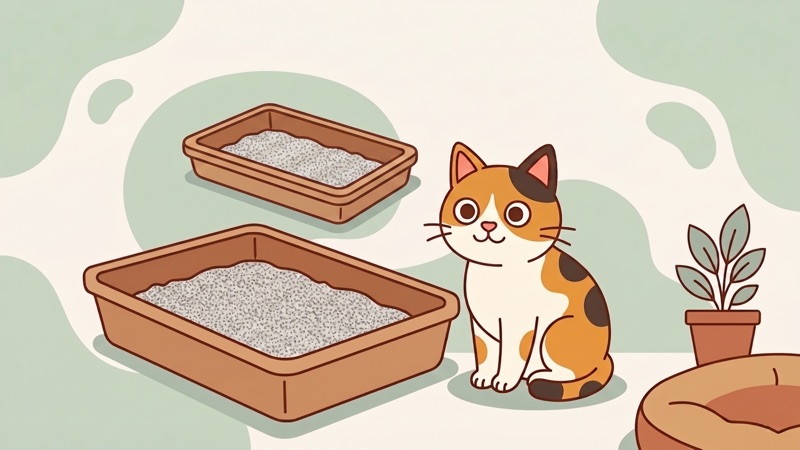
Food and water should not be side by side with the litter box. Cats evolved to keep their toilets away from their food, and many will reject one or both if they’re too close. In multi-cat homes, the working rule for litter boxes is one per cat plus one extra, placed in different rooms or at least different corners. Two boxes lined up next to each other count as one. Water bowls placed in several locations, away from walls, tend to get used more than a single bowl in a corner. Scratching posts should be tall enough for a full stretch and placed near resting areas, not hidden in the basement.
The mistake most multi-cat households make is concentrating everything in one spot. It looks tidy but forces cats into repeated low-grade conflict over access.
Pillar 3: Opportunities to play and hunt
Cats are predators. Indoor cats still have the full instinctual drive to stalk, chase, pounce, and catch, and when that drive has nowhere to go, it often turns into the symptoms at the top of this article. Daily interactive play, the kind where you move a wand toy like prey and let the cat actually “catch” it at the end, does more for a cat’s mental health than most owners realize.
One note on laser pointers. A wand toy works because the hunt has an ending: the cat actually catches something physical. A laser doesn’t, and the hunt never completes. A 2021 survey of 618 cats found that frequent laser play was associated with more guardian-reported abnormal repetitive behaviors, especially chasing lights, staring at reflections, and fixating on specific objects (Kogan & Grigg, 2021). The data is correlational rather than causal, but it matches what behaviorists have long suspected about predatory frustration. If you use a laser, end every session by landing the light on a physical toy or a treat on the floor, so the cat gets an actual catch.
Food puzzles are the other half of this. Cats evolved to hunt many small meals across a day, not to find a bowl of pellets waiting in one place. Rotating a few simple puzzle feeders gives a cat something to work for, which keeps their brain busy and tends to settle them down. “The cat can entertain itself” is sometimes true and sometimes an excuse. Most indoor-only cats benefit from at least one structured play session a day, even just ten minutes.
Pillar 4: Consistent, predictable human interaction
Cats do form deep bonds with their people, but they prefer those bonds on their terms. The single most stress-relieving thing an owner can do is be predictable: wake up at similar times, feed at similar times, initiate petting the same way, stop when the cat’s body language says to stop.
Children and visitors are where this usually breaks down. A cat that has learned “humans are predictable” will not extend that trust to a loud three-year-old or a hugging aunt. A safe space the cat can retreat to (Pillar 1) is what keeps those interactions survivable. Let the cat approach first. Don’t pick it up for a cuddle it didn’t ask for. End every interaction a few seconds before the cat would end it on its own.
Pillar 5: Respect for the cat’s sense of smell
Cats rely on scent to feel oriented in their own home. Things that make sense to us can be unsettling to a cat: strong cleaning products, scented litter, new furniture that doesn’t smell like anything familiar, a deep clean of every cat bed at once.
The practical version of this pillar: use unscented litter, avoid scented cleaning products on surfaces the cat lives on, and when you wash cat bedding, leave at least one unwashed item behind. After a move or new furniture, a synthetic pheromone diffuser (Feliway is the most studied) can help bridge the scent gap while the cat lays down its own markers. Never punish a cat for scratching or rubbing cheeks on things. That isn’t vandalism. That’s your cat writing “I live here” in a language you can’t read.
When to see a vet
Environmental changes help a lot of stressed cats, but they aren’t a substitute for a medical workup when one is needed.
Go to the vet if: over-grooming has caused bald skin, sores, or scabs; your cat is straining to urinate, urinating very small amounts, or there’s blood in the urine (this can become a medical emergency in male cats within 24 hours); appetite has dropped for more than 24 to 48 hours; behavior changes came with weight loss, vomiting, or other physical symptoms; or your cat has hidden continuously for more than a day with no obvious trigger.
Vets can also prescribe short-term anti-anxiety medication when environmental changes alone aren’t enough, especially around a move or after losing a companion animal.
The shortest version of this article
If your cat is doing something strange and you’ve already ruled out illness, look at what changed in its environment recently, and look at whether its environment gives it control over where it sleeps, what it eats, where it goes to the toilet, and when it interacts with you. Most feline stress resolves when those four things feel predictable and safe. The five pillars exist because they’re the difference between a cat that tolerates its home and a cat that actually feels okay in it. If your cat’s litter box habits changed suddenly, start with a vet visit. If the behavior is newer and subtler, start with the environment.
Frequently Asked Questions
How do I know if my cat is actually stressed or just being a cat? Occasional hiding, short bursts of grooming, or a skipped meal aren’t stress in the clinical sense. The signs that matter are the ones that persist or that appeared after something changed at home. Look for hiding that lasts more than a day, over-grooming severe enough to thin the coat or cause bald patches, peeing or pooping outside the litter box, sudden aggression or flinchiness, compulsive behaviors, or changes in appetite and sleep. Rule out medical causes first with a vet, then look at what changed in the environment.
Will getting a second cat help my lonely cat? Sometimes, but often not. Many cats are perfectly content as the only cat in a household, and adding a new cat without a slow introduction is one of the most common causes of inter-cat stress. If you do introduce a second cat, follow a multi-week introduction protocol and make sure each cat has its own food, water, litter box, and safe space. The working rule is one litter box per cat plus one extra, placed in different rooms.
Do pheromone diffusers like Feliway actually work? Synthetic feline facial pheromone (the active ingredient in Feliway Classic) has the most research behind it of the over-the-counter options, with studies suggesting modest benefits during stressful situations like moves, vet visits, and new environments. It isn’t a substitute for fixing the underlying environmental problem, but it can help bridge the gap during major transitions. It’s most effective when combined with the environmental changes described in the AAFP/ISFM feline environmental needs guidelines.
How long does it take for a stressed cat to settle down after a big change? Most cats adjust to a major change like a move or a new household member within two to six weeks if their environment gives them control and safe spaces. Some cats settle in days. Others take months, especially after losing a companion animal or after a new baby or pet. If behavioral signs like hiding, over-grooming, or litter box avoidance are still present after six to eight weeks, talk to your vet about whether short-term anti-anxiety medication or a behavior consult would help.
References
- Ellis, S. L. H., Rodan, I., Carney, H. C., Heath, S., Rochlitz, I., Shearburn, L. D., Sundahl, E., & Westropp, J. L. (2013). AAFP and ISFM feline environmental needs guidelines. Journal of Feline Medicine and Surgery, 15(3), 219-230.
- Buffington, C. A. T. (2011). Idiopathic cystitis in domestic cats: beyond the lower urinary tract. Journal of Veterinary Internal Medicine, 25(4), 784-796.
- Amat, M., Camps, T., & Manteca, X. (2016). Stress in owned cats: behavioural changes and welfare implications. Journal of Feline Medicine and Surgery, 18(8), 577-586.
- Kogan, L. R., & Grigg, E. K. (2021). Laser light pointers for use in companion cat play: association with guardian-reported abnormal repetitive behaviors. Animals, 11(8), 2178.
- Barrios, N., Tejedor, D., & Mota-Rojas, D. (2025). Tools for the approach of fear, anxiety, and stress in the domestic feline: an update. Veterinary Medicine International, 2025, 9109397.
- Cornell University College of Veterinary Medicine. Feline Behavior Problems. Cornell Feline Health Center
- Ohio State University Veterinary Medical Center. Indoor Pet Initiative. Indoor Pet Initiative