
Cat hair gets everywhere. It is on the couch, on your clothes, woven into the throw blanket you washed only yesterday. Most of the time that is simply what living with a cat looks like, and there is nothing to fix. But shedding sits next to a few things that do matter: a coat that thins in patches rather than evenly, mats that pull at the skin, and the hair your cat swallows while grooming itself. This guide covers how to tell ordinary shedding from a warning sign, how often to brush and how to do it well, how to deal with mats without hurting your cat, and where shedding and hairballs meet.
Is it normal, or a sign of trouble?
Most shedding is completely normal, and the amount of hair you find around the house is a poor guide to whether anything is wrong. A heavy shedder can be perfectly healthy. The thing to pay attention to is not how much hair comes off, it is whether the coat itself is changing.
With normal shedding, the coat still looks like a coat. It stays even in thickness, length, and density, even while tufts collect on the furniture and the occasional hairball turns up. What should make you look closer is hair loss that leaves a mark: bald patches, areas that have gone visibly thin, fur that looks broken or stubbly, or skin that is red, scabbed, sore, or smells off. A cat that licks, scratches, or chews one area until it is bare is telling you something itches or hurts there.
Then there are signs that point away from the skin entirely. If thinning fur comes alongside weight loss, drinking and urinating more than usual, a change in appetite, vomiting, or a drop in energy, the coat is not the real problem, it is a symptom. That combination is worth a vet visit sooner rather than later.
Hair loss is a symptom rather than a disease, so it is worth knowing what tends to sit behind it. Most traumatic hair loss is the cat doing it to itself because something itches, and one of the most common causes of that itch is an allergy to flea bites. It does not take an infestation. In a sensitive cat, a single bite can set off enough itching to pull a patch of fur out, which is why parasite control matters even for indoor cats. Other parasites such as mites can do the same, and ringworm, which is a fungus rather than a worm, causes patchy hair loss too. In older cats, an overactive thyroid is a common driver of coat changes, and diabetes can affect the coat as well.
Stress is the cause owners most like to land on, and it is real: some cats overgroom when anxious. But it is worth being slow to assume it. Vets treat compulsive overgrooming as a diagnosis of exclusion, and when cats sent in as “stress groomers” are actually worked up, roughly three out of four turn out to have a physical cause such as an allergy or pain. So if your cat is barbering its belly bare, a vet check comes before any conclusion about anxiety.
Why cats shed
Shedding is just the back end of how hair works. Each hair grows for a stretch, rests, and is eventually pushed out and replaced by a new one. Because a cat’s hairs are not all on the same schedule, there is always some falling out somewhere, which is why a cat sheds a little all the time rather than all at once.
How much you notice depends on the coat. Most cats have a thick, double-layered coat: an outer layer of protective guard hairs sitting over a soft, dense undercoat that does the insulating. Some breeds have a thinner coat with little or no undercoat. The undercoat tends to be the heavier shedder, so cats with a full double coat, and long-haired cats like Maine Coons and Persians, simply drop more fur than a sleek, thin-coated cat.
Season plays a part too, and the main trigger is daylight length rather than temperature. A cat with access to the outdoors picks up the lengthening days of spring and clears out its thick winter undercoat in a big seasonal shed, with a smaller change in autumn. Indoor cats live under steadier artificial light and heating all year, so that seasonal signal is muted and many of them shed fairly evenly across the months instead. If your indoor cat seems to shed constantly, that is usually normal, not a fault.
The coat is also a rough mirror of general health. A cat eating a complete, good-quality diet usually carries a glossy coat that sheds in a healthy way. A coat that turns dull, greasy, or brittle, or starts shedding noticeably worse, can occasionally be an early flag of a nutritional gap or an underlying problem, and is worth raising with your vet rather than treating with a supplement off the shelf.
How to brush your cat
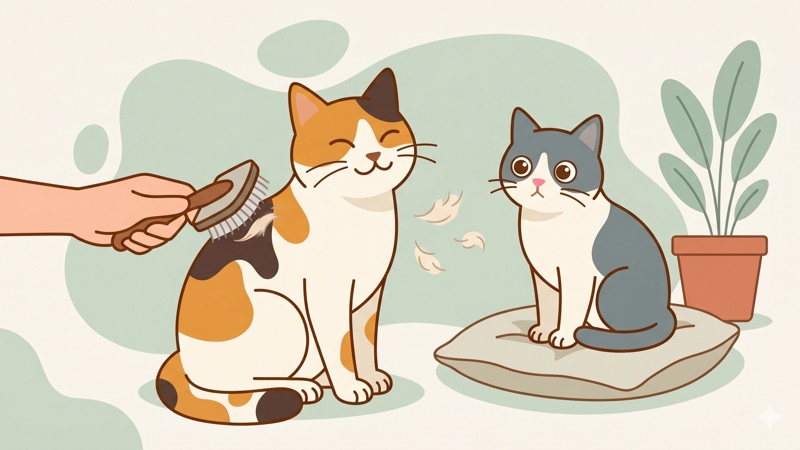
Brushing is the one thing that turns shedding from a background nuisance into something you can manage. Every hair you catch on a brush is a hair that does not end up on the sofa or, more importantly, swallowed.
How often depends on the coat. A short-haired cat does well with a brush about once a week. A long-haired cat needs it daily, or every other day at the least, because a long coat that gets skipped starts to tangle within days. For a short coat, a soft brush or a rubber grooming mitt is enough. For a long coat, a slicker brush paired with a metal comb works better, because the comb reaches down into the undercoat that the brush glides over.
Technique is simple. Brush in the direction the hair grows, working from the head down toward the tail, and follow with the comb on a long coat to catch what is left underneath. Pay extra attention to the friction zones where tangles start: the armpits, the belly, between the hind legs, behind the ears, and around the neck. Keep sessions short and pleasant, pair them with treats, and stop before your cat has had enough rather than after. A kitten that learns young that brushing is normal will be far easier to groom for the rest of its life.
Grooming earns its place twice over, because it is also the best routine health check you have. Your hands find things your eyes would miss: a small lump, a scab, a fleck of flea dirt, a patch of skin that is tender when touched. It pairs naturally with a quick look at the claws, which our nail care guide covers. Older cats deserve special attention here. Stiff joints and dental discomfort mean a senior cat grooms itself less thoroughly, so its coat can turn greasy and start to mat, and it needs you to pick up the slack, something our senior cat care guide looks at alongside the other quiet changes of age.
Mats, and how to deal with them safely
A mat forms when loose shed hair does not fall away cleanly and instead tangles into the coat still on the cat, tightening over time into a dense pad. They show up in the same friction zones that need the most brushing: armpits, behind the ears, between the hind legs, the belly, and around the rear. A mat is not just untidy. It pulls on the skin every time the cat moves, and a tight one can tear or bruise the skin beneath it and trap moisture against it until the skin becomes sore or infected.
A small, loose mat you can often handle at home. Work it apart with your fingers first, holding the base of the mat where it meets the skin so you are pulling the mat and not the skin itself. Then take a comb to it from the tip of the hair inward, in small bites, easing the tangle loose a little at a time rather than dragging through it. A sprinkle of cornstarch can help the hair slide apart, and a dematting comb handles slightly larger tangles. Keep sessions short, and if your cat is getting upset, stop and come back later.
Never cut a mat out with scissors
It is one of the most common ways owners accidentally injure their cats during grooming. A tight mat lifts the skin up into itself, so the skin tents into the base of the mat where you cannot see it. Scissors slid under a mat catch that skin, and the result is a cut that often needs stitches. If a mat will not come apart with a comb, do not reach for scissors. Leave it for a vet or groomer, who can shave it off safely with electric clippers.
Some mats are past the point of home treatment. If a mat is large, tight against the skin, or your cat is clearly in pain or the skin underneath looks red and raw, that is a job for a vet or a groomer. They will clip it away with electric clippers, sometimes with light sedation so it can be done calmly and without hurting the cat. Battling a severe mat at home is not worth the fight, and the skin underneath one may need treatment anyway. The real fix for mats is preventing the next one, and that comes back to brushing often enough that loose hair never gets the chance to tangle.
Shedding and hairballs
The hair your cat sheds does not all land on the floor. A grooming cat swallows a good deal of it, and while most passes straight through and out, some collects in the stomach and comes back up as a hairball. The connection is the reason brushing matters beyond just keeping the house tidy: hair caught on your brush is hair your cat cannot swallow. If hairballs are a regular event in your home, our hairball guide goes into what is normal, what is not, and how to cut them down.
How Furwise can help
Grooming is easy to let slide, because nothing forces the issue until a mat has already formed or the shedding has gotten out of hand. Furwise lets you log grooming sessions and set a gentle reminder, so a long-haired cat gets brushed on a rhythm that stays ahead of tangles instead of catching up after them. When you do notice something on the coat, a new thin patch, a scab, more shedding than the cat’s usual, you can note it with a date, so that by the time you are at the vet you have a record rather than a vague impression. In a multi-cat home, per-cat notes keep track of which cat needs daily brushing and which one barely needs your help at all.
Shedding, in the end, is mostly just what owning a cat feels like, and the goal is not to stop it. The things that actually deserve your attention are narrower: a coat that is changing rather than simply shedding, a mat caught while it is still small, and a brush used often enough to keep loose hair off the cat and out of its stomach. Stay on those, and the rest is just hair on the blanket.
Frequently Asked Questions
Why is my indoor cat shedding so much, even in winter? That is normal for an indoor cat. Seasonal shedding is triggered by changes in daylight length, and an indoor cat lives under steady artificial light and heating all year, which mutes the seasonal signal. Instead of one big spring shed, indoor cats tend to shed fairly evenly in every month. As long as the coat itself stays even in thickness with no bald patches or skin trouble, year-round shedding is not a problem.
How often should I brush my cat? It depends on the coat. A short-haired cat does well with a brush about once a week. A long-haired cat needs brushing daily, or every other day at the least, because a long coat tangles within days if it is skipped. Brush in the direction the hair grows and pay extra attention to the armpits, belly, behind the ears, and between the hind legs, where mats tend to start.
When is shedding a sign of a health problem? The amount of hair matters less than whether the coat is changing. Watch for bald patches, visibly thin areas, broken or stubbly fur, or skin that is red, scabbed, sore, or smells off, and for a cat that licks or scratches one spot bare. Shedding that comes alongside weight loss, increased thirst, appetite changes, vomiting, or low energy points to a problem beyond the skin and is worth a prompt vet visit.
Can I cut a mat out with scissors? No. This is one of the most common ways owners accidentally injure cats while grooming. A tight mat pulls the skin up into its base, so the skin is hidden inside the tangle where you cannot see it, and scissors slid underneath can cut the cat badly enough to need stitches. Work small mats apart with your fingers and a comb instead. If a mat will not come loose, have a vet or groomer shave it off safely with electric clippers.
Do short-haired cats need brushing? Yes, just less often than long-haired cats. Once a week with a soft brush or a rubber grooming mitt removes loose hair before it ends up on the furniture or swallowed, spreads the natural oils that keep the coat healthy, and gives you a regular chance to feel for lumps, scabs, or fleas. Short coats mat far less than long ones, but they still shed, and brushing still helps.
Will bathing or shaving my cat reduce shedding? Neither is a good shedding fix. Cats groom themselves well and rarely need baths, and over-bathing can dry the skin and make the coat worse. Shaving a healthy coat is not advised either: the coat insulates against both heat and cold and protects the skin, and it can grow back unevenly. Regular brushing is the safe and effective way to manage shedding. Shaving is best reserved for severe mats, done by a professional.
References
- International Cat Care. Grooming Your Cat. iCatCare
- Texas A&M College of Veterinary Medicine & Biomedical Sciences. A Thin Line: Normal Shedding vs. Feline Alopecia. Texas A&M VMBS
- VCA Animal Hospitals. Grooming and Coat Care for Your Cat. VCA
- Cornell Feline Health Center. Hyperthyroidism in Cats. Cornell University
- Waisglass, S. E., Landsberg, G. M., Yager, J. A., & Hall, J. A. (2006). Underlying medical conditions in cats with presumptive psychogenic alopecia. Journal of the American Veterinary Medical Association, 228(11), 1705-1709. PubMed