
Most cat owners have stepped on one at some point: a damp, cigar-shaped lump on the floor, usually discovered barefoot at 6 AM. Hairballs are so common that many people consider them a normal part of having a cat. But veterinary thinking on this has been shifting. Frequent hairball vomiting is often a sign that something else is going on.
What a hairball actually is
A hairball (trichobezoar) is a wad of undigested hair mixed with bile and digestive fluids. Despite the name, they’re usually cylindrical, not round, because they pass through the tube-shaped esophagus on the way out. A typical one is a few centimeters long, though they can get much larger if they stay in the stomach.
Cats swallow hair because of how their tongues work. A 2018 study using micro-CT scans discovered that cat tongue papillae are hollow, not solid as previously assumed (Noel & Hu, 2018). These tiny U-shaped scoops wick saliva deep into the fur and catch loose hairs along the way. Cats spend roughly a quarter of their waking hours grooming, so over time quite a bit of hair goes down. Most of it passes through the digestive tract and comes out in feces without any trouble. It’s when hair accumulates faster than the gut can move it along that problems start.
”Normal” might not be normal
Frequent hairball vomiting is hard to call normal, and in many cats it signals underlying gastrointestinal disease, excessive grooming from skin conditions, or both. Dr. Martha Cannon argued exactly that in a 2013 review in the Journal of Feline Medicine and Surgery (Cannon, 2013), against the traditional view that hairballs are just a harmless quirk.
The logic is straightforward: if most swallowed hair passes through in feces, a cat that regularly vomits hairballs may have a motility problem preventing hair from moving through normally. Conditions like inflammatory bowel disease (IBD) slow gut transit, and the hair accumulating in the stomach is a symptom, not the root cause.
This doesn’t mean every single hairball is a medical emergency, but there is no safe number below which hairballs are simply normal. Surveys in first-opinion practice found that roughly one in ten apparently healthy short-haired cats vomit hairballs, and about twice that proportion of long-haired cats, so producing them at all is not a given. Three things matter more than a count: whether the frequency is climbing, whether it comes alongside weight loss or other GI signs, and whether your cat is short-haired. A short-haired cat swallows less hair to begin with, so one that brings up hairballs is worth a closer look. Raising it at the next check-up is more useful than tallying episodes at home.
Who’s more at risk
Long-haired breeds like Persians, Maine Coons, and Ragdolls produce more loose hair per grooming session. In a study of five cats with hairball-related intestinal obstruction, four were long-haired (Barrs et al., 1999).
Older cats tend to be more thorough groomers than kittens, so they ingest more hair over time. In cats over 10, a hairball obstruction may also be associated with more serious conditions. A 2023 study of 44 cats with trichobezoar obstructions found that older cats were more likely to have concurrent alimentary lymphoma (Gollnick et al., 2023).
Cats with skin conditions that cause itching, like flea allergy dermatitis, will groom excessively and swallow much more hair than usual.
Cats with GI disease, particularly IBD or motility disorders, may struggle to pass hair through the digestive tract normally.
Seasonal shedding increases loose hair, so spring and fall may bring more hairballs even in cats that rarely have them otherwise.
What actually helps
Regular brushing
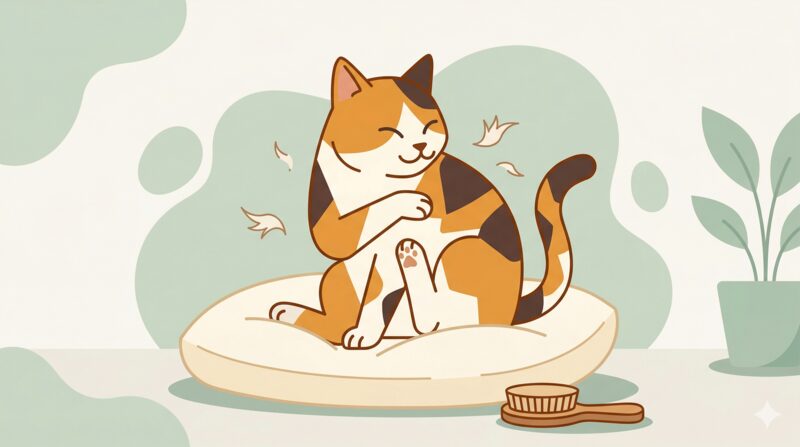
This is the simplest and most universally recommended approach. Removing loose hair before your cat swallows it means less hair reaching the stomach. Daily brushing for long-haired breeds, a few times a week for short-haired cats, and our cat shedding guide covers brushing technique by coat type. During heavy shedding seasons, increase the frequency.
Dietary fiber
This is the approach with the most research behind it. Fiber increases gut motility, which helps hair move through the digestive tract and exit in feces instead of being vomited back up.
A crossover trial of 102 cats found that cats on a high-fiber diet had 21.5% fewer hairballs and 21.8% less vomiting than cats on a standard diet (Moreno et al., 2022). Another study showed that long-haired cats on elevated fiber with psyllium excreted 81-113% more hair in their feces (de Godoy et al., 2017). A separate trial found that sugarcane fiber specifically reduced hairball formation in a dose-dependent manner (Loureiro et al., 2014).
If your cat has frequent hairballs, talk to your vet about a higher-fiber diet. This doesn’t necessarily mean a commercial “hairball formula” food. Your vet can recommend the right fiber level and type for your cat’s situation.
Petrolatum-based laxatives
Products like Laxatone have been used for decades. The idea is that the petroleum jelly coats the hair and helps it slide through the GI tract. They’re generally safe and many vets recommend them, but the peer-reviewed evidence for their effectiveness is limited. They’re reasonable to try for mild cases, but if your cat needs them constantly, the underlying cause deserves investigation.
Addressing the root cause
If hairballs are frequent, the most effective long-term approach is figuring out why. Maybe it’s a skin condition driving overgrooming, or an undiagnosed GI problem slowing transit. Treating the underlying issue often resolves the hairball problem as a side effect.
When to see the vet
See a vet if you notice
- Repeated retching or gagging without producing anything
- Loss of appetite lasting more than a day
- Lethargy or unusual withdrawal
- Constipation or absence of stool
- Abdominal pain (hunched posture, resisting being picked up)
- Hairball vomiting becoming more frequent than it used to be
- A short-haired cat bringing up hairballs regularly
The first five signs on that list could indicate a hairball obstruction, which is uncommon but potentially fatal. When a hairball gets too large to pass, it can lodge in the small intestine and block it. A study of five cats with hairball obstructions found that two did not survive (Barrs et al., 1999). Obstruction typically requires imaging (X-ray or ultrasound) and sometimes emergency surgery.
The last two signs suggest the hairball issue may be a symptom of something else. Your vet can check for IBD, food sensitivities, skin conditions, and in older cats, rule out more serious GI disease.
Common misconceptions
“Hairballs are a normal part of having a cat.” Common, yes. Normal, not necessarily. Most swallowed hair should pass through in feces. Frequent vomiting of hairballs often points to an underlying issue worth investigating.
“Hairballs are round.” Almost never. They’re cigar-shaped because they’re squeezed through the cylindrical esophagus. They only become round if they stay in the stomach long enough to compact, which usually means they’re too big to come up.
“My cat is coughing up a hairball.” Coughing involves the airways. Hairballs come from the stomach. A cat that repeatedly appears to be “coughing up a hairball” but never produces one may actually have asthma or another respiratory condition. That’s a vet visit, not a hairball issue. Our vomiting guide covers how to tell vomiting from other look-alikes.
“Short-haired cats don’t get hairballs.” They can, though less often. When a short-haired cat produces hairballs frequently, it’s actually a stronger warning sign because they swallow less hair. Something else is likely contributing.
Hairballs don’t have to be something you just live with. For most cats, regular brushing and appropriate fiber in the diet keep things under control. When they become frequent, that’s worth a vet visit, not just another mess to clean up.
Frequently Asked Questions
Are hairballs normal for cats? There is no safe number below which hairballs are simply normal. Surveys in first-opinion practice found that roughly one in ten apparently healthy short-haired cats vomit hairballs, and about twice that proportion of long-haired cats, so producing them at all is not a given. What matters is whether the frequency is climbing, whether it comes alongside weight loss or GI signs, and whether your cat is short-haired. Frequent hairball vomiting can point to underlying gastrointestinal disease, excessive grooming driven by a skin condition, or a motility problem.
How can I prevent my cat from getting hairballs? Regular brushing removes loose hair before your cat swallows it. Dietary fiber helps hair pass through the digestive tract in feces. A crossover trial of 102 cats showed 21.5% fewer hairballs on a high-fiber diet. Talk to your vet about the right approach for your cat.
When should I take my cat to the vet for hairballs? See a vet if your cat has repeated retching without producing anything, loss of appetite, lethargy, constipation, or abdominal pain, as these may indicate a hairball obstruction. Also consult a vet if the frequency is increasing, or if a short-haired cat is bringing up hairballs regularly.
References
- Cannon, M. (2013). Hair Balls in Cats: A normal nuisance or a sign that something is wrong? Journal of Feline Medicine and Surgery, 15(1), 21-29. PMC
- Noel, A. C., & Hu, D. L. (2018). Cats use hollow papillae to wick saliva into fur. Proceedings of the National Academy of Sciences, 115(49), 12377-12382. PMC
- de Godoy, M. R. C., et al. (2017). Influence of dietary fibre levels on faecal hair excretion after 14 days in short and long-haired domestic cats. Journal of Animal Physiology and Animal Nutrition, 101(5), e73-e82. PMC
- Loureiro, B. A., et al. (2014). Sugarcane fibre may prevent hairball formation in cats. Journal of Nutritional Science, 3, e20. PMC
- Moreno, A. A., et al. (2022). Dietary fiber aids in the management of canine and feline gastrointestinal disease. JAVMA, 260(S3), S61-S74. JAVMA
- Barrs, V. R., et al. (1999). Intestinal obstruction by trichobezoars in five cats. Journal of Feline Medicine and Surgery, 1(4), 199-207. PMC
- Gollnick, N. S., et al. (2023). Histopathologic diagnosis and patient characteristics in cats with small intestinal obstructions secondary to trichobezoars. JAVMA, 261(12), 1830-1836. PubMed
- Cornell University College of Veterinary Medicine. (2024). The Danger of Hairballs. Cornell Feline Health Center