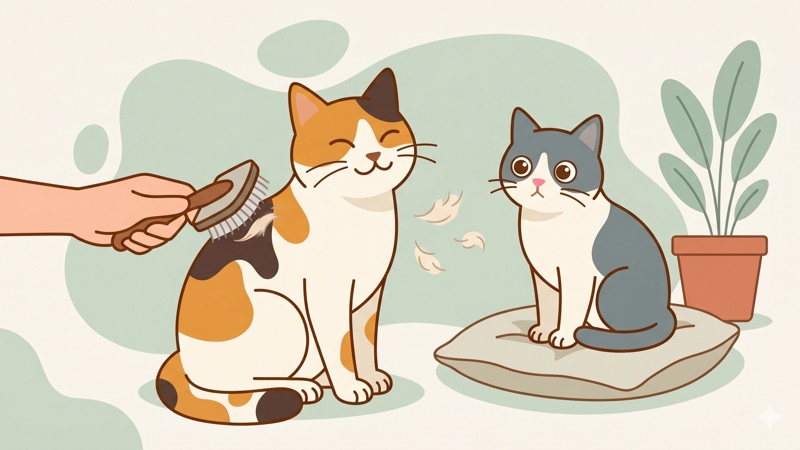

For a lot of owners, nail care is the chore that never quite happens. The clippers feel risky once you have heard about the quick, and the scratching post in the corner sits ignored while the sofa quietly comes apart. Those two problems are closer than they look. A cat’s claws need two things from you: an occasional trim when they grow too long, and a good place to scratch so the cat can keep the rest in order itself. This guide covers when a trim is actually needed, how to do it without a fight, what to do if you nick the quick, and why scratching is something to redirect rather than stop.
Do you even need to trim?
Not every cat needs regular nail trims, and it is worth knowing which kind you have before you reach for the clippers. A cat that goes outdoors, climbs a lot, and uses a scratching post wears its claws down naturally, and its nails may never need your help. For these cats the claws are working tools, used for traction, climbing, and defence, so leaving them alone is usually the right call unless a vet has told you otherwise.
The cats that do tend to need trims are indoor cats, less active cats, kittens with needle-sharp claws, and older cats whose claws no longer wear down the way they once did. Even then, the right approach is to inspect rather than follow a fixed calendar. Every couple of weeks, gently press the top and bottom of a toe to extend the claw and take a look. If the tips are getting long, curving sharply, or catching on carpet and clothing, it is time. If they look fine, leave them. Most indoor cats land somewhere around a trim every two to four weeks, but that is an average, not a rule, and your own cat will tell you more than the number does.
How to trim, step by step
Inexpensive clippers made for cats, either the small scissor style or the guillotine style, are shaped for a curved claw and make the job easy. Human nail clippers can also work, as long as you turn them so the blades cut the nail from top to bottom rather than side to side, which keeps the nail from splitting. Keep a separate pair for the cat rather than sharing your own.
The handling matters as much as the tool. Pick a calm moment, ideally when your cat is sleepy and relaxed rather than playful, and have a few treats ready. Do not scruff or pin your cat. That turns the whole thing into something to dread and makes the next trim harder. If your cat squirms, a loose towel wrap with one paw free at a time gives you control without a wrestling match. With a kitten, the trim itself is almost beside the point at first. Spend a week simply handling the paws, pressing gently to pop a claw out, and giving a treat each time, so the equipment becomes boring rather than alarming. Starting this young pays off for years, and our guide to bringing home a kitten covers the wider settling-in routine.
To trim, hold the paw gently and press the toe pad to extend one claw. Look for the quick, the pink core inside the nail that carries blood vessels and nerves. You are cutting only the clear or white tip, stopping a couple of millimetres short of where the pink begins. Cutting into the quick hurts and bleeds, so when in doubt, take less. If your cat has dark claws and you cannot see the quick at all, trim only the very tip, the thin hook at the end, and accept that you will be doing a smaller, safer cut. There is no prize for a short nail, and a vet or groomer can show you the technique in person if dark claws make you nervous.
You do not have to finish every claw in one sitting. A nail or two, a treat, and a break is a perfectly good trim, and it beats forcing a frightened cat to sit through all eighteen. In practice the front claws are the ones that need your attention. The back claws grow more slowly and stay blunter, and many cats keep them worn down without any help. Do not forget the dewclaw, though, the small thumb-like claw higher up on the inside of each front paw. It never touches the ground, so it is the one most likely to overgrow.
If you cut the quick
It happens to almost everyone eventually, and a nicked quick is a minor injury rather than an emergency. The nail will bleed and your cat will object. Press a pinch of styptic powder onto the tip of the nail and hold gentle pressure for several seconds; cornstarch works if you have no styptic powder. The bleeding usually stops quickly. Stay calm and let the trim end there for the day, but do not wrestle a panicking cat to keep pressure on the nail, because a bad bite is the worse injury and the bleeding will stop on its own. Call your vet if the bleeding has not stopped after about ten minutes of pressure, if the nail is torn or partly detached rather than just nicked, or if the toe swells or your cat will not put weight on the paw.
Overgrown nails, ingrown claws, and senior cats
When claws are not worn down or trimmed, they keep growing in a curl. The dewclaw is the usual troublemaker, because it has no contact with the floor and nothing to blunt it. Left long enough, an overgrown claw can curve all the way around and grow into the paw pad. That is an ingrown nail, and it is painful. The area can become infected too. A cat with one may limp, lick or chew at the paw, or stop wanting that foot touched.
This is most common in senior cats, and the reasons stack up. Older cats move around less, so their claws wear down less. The nails themselves often grow thicker and more brittle with age, and cats shed the worn outer layers less effectively. A claw that a younger cat would have kept tidy on its own can quietly overgrow in a senior. If you share your home with an older cat, make paw checks part of the routine; our senior cat care guide covers the other small changes worth watching for.
An ingrown nail is not a home job. Freeing the claw and treating the pad usually needs a vet, sometimes with sedation so it can be done without distressing the cat. Do not try to dig it out yourself. The fix is straightforward in a clinic, and the more useful thing you can do afterwards is keep that claw trimmed so it does not happen again.
Why cats need to scratch
The other half of nail care is not something you do to the cat. It is something the cat does for itself. Claws are made of keratin and grow in layers, and scratching drags off the worn outer sheath to reveal the sharper claw underneath. That is why you sometimes find a curved, hollow nail shell stuck in a scratching post or a rug. Scratching also gives a cat a full-body stretch, and it leaves both a scent mark from glands in the paws and a visible mark, which is how cats stake out territory.
All of this means scratching is normal, healthy behaviour, not a fault to train out. A cat that scratches is simply being a cat. When the target is your sofa, the problem is not the scratching itself, it is the location, and the location is something you can change. The goal is to make a scratching post the obvious, satisfying choice and the furniture the boring one.
Solving furniture scratching
Cats pick furniture for sensible reasons. A sofa arm is tall, rock solid, sits in the middle of the room, and has a texture that feels good under the claws. Beat it by giving the cat something that does the same job better.
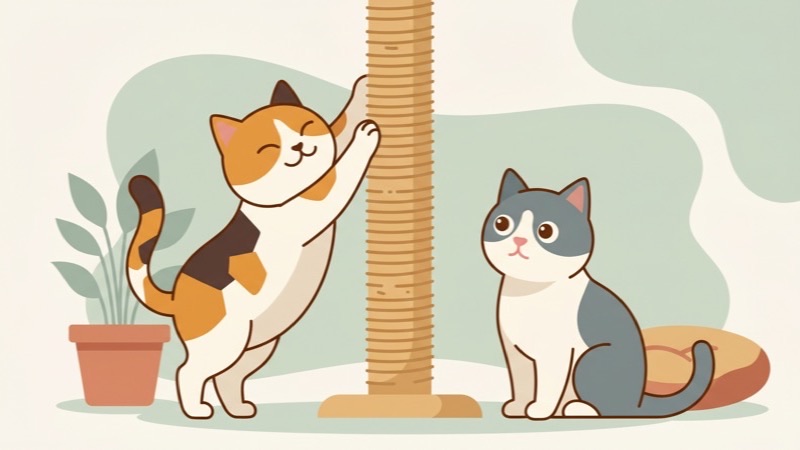
Height comes first. A scratching post needs to be tall enough for your cat to reach up and scratch at a full stretch, which for most adult cats means around three feet or taller. A short, stubby post simply cannot deliver the stretch, so the cat skips it. Stability is just as important. If a post wobbles or tips when leaned on, a cat will abandon it after one try and go back to the dependable sofa. Look for a heavy base or a post that mounts to the wall or floor.
Texture and shape are worth experimenting with. Many cats take readily to sisal rope, and corrugated cardboard is another favourite, while some cats prefer to scratch horizontally on a flat pad or mat rather than vertically. Offering both a tall vertical post and a horizontal option lets the cat show you its preference. Placement then decides whether any of it gets used. Put the post where the cat already wants to scratch, right next to the abused furniture, not tucked away in a spare room. Cats also like to scratch where they sleep and where they greet you, so a post near a favourite napping spot or by a doorway tends to earn its keep. In a larger home, or a home with several cats, one post is rarely enough; spread a few around, and see our multi-cat household guide for how to share resources without friction.
When you catch your cat using the post, make it pay off with quiet praise or a treat, because cats that get rewarded for scratching the right thing use the post far more. Avoid punishment for scratching the wrong thing. It does not teach a cat where it should scratch, it just teaches the cat to be wary of you, and the scratching simply moves to when you are not watching. If a particular spot on the furniture is a stubborn favourite, make it temporarily unappealing with double-sided tape or a cover while the new post becomes a habit.
A word on declawing
Declawing is sometimes offered as a permanent fix for scratching, and it is important to be clear about what it actually is. Declawing, or onychectomy, is not a nail trim or a clipping. It is the surgical amputation of the last bone of each toe, the only way to remove the claw permanently. The American Veterinary Medical Association discourages elective declawing, and the American Association of Feline Practitioners strongly opposes it, because it is acutely painful and can lead to lasting problems, including chronic pain, an altered gait, and new behaviour issues. It is banned or restricted in a growing number of countries and regions.
The encouraging part is that it is almost never necessary. Regular trimming combined with good scratching posts manages claws well in the vast majority of homes. For the small number of cats that keep causing damage or injury despite all of that, soft plastic nail caps are a non-surgical option: they glue over the trimmed claw, last several weeks before they need replacing, and, when fitted correctly, still let the claw retract normally. They are a tool for specific situations, not a routine substitute for a post and a trim.
How Furwise can help
Nail care slips through the cracks because nothing reminds you. There is no daily mealtime cue, just a slow drift from fine to too long. Furwise lets you log the date of the last trim and set a gentle reminder so the next check does not depend on noticing a snagged claw. You can keep a quick note for each cat, which matters in a multi-cat home where one cat needs trims and another never does, and jot down anything you spotted, a thickening dewclaw or a tender paw, so it is in front of you at the next vet visit.
Nail care comes down to two habits that take very little time. Check the claws every couple of weeks and trim only when they actually need it, and give your cat a tall, sturdy, well-placed post so it can handle the rest itself. Do that, and the clippers stop feeling risky and the furniture stops being the target.
Frequently Asked Questions
How often should I trim my cat’s nails? There is no universal schedule. Many indoor cats do well with a trim every two to four weeks, but active cats and outdoor cats may need none at all, while some seniors need them more often. Rather than trimming on a fixed date, check the claws every couple of weeks by gently pressing a toe to extend the nail. Trim only if the tips are long, sharply curved, or catching on things. If they look fine, leave them.
Can I use human nail clippers on my cat? You can. Cat clippers, either the scissor style or the guillotine style, are inexpensive and shaped for a curved claw, so they are the easier choice. If you use human nail clippers instead, turn them so the blades cut the nail from top to bottom rather than side to side, which stops the nail from splitting. Keep a separate pair for the cat rather than sharing your own.
What should I do if I cut the quick and it bleeds? Stay calm, because a nicked quick is a minor injury, not an emergency. Press a pinch of styptic powder onto the bleeding tip and hold gentle pressure for several seconds; cornstarch works if you have no styptic powder. The bleeding usually stops quickly. Do not fight a panicking cat to keep pressure on, since a bite is the worse outcome and the bleeding will stop by itself. Contact your vet if the bleeding has not stopped after about ten minutes, if the nail is torn rather than just nicked, or if the toe swells or your cat will not bear weight on the paw.
What if my cat won’t let me trim their nails? Go slower and smaller. Trim just one or two nails at a time, reward each one, and stop before your cat gets upset rather than after. Choose a sleepy, calm moment, and spend a few sessions simply handling the paws with treats before you cut anything. A loose towel wrap can help with a wriggler. If trimming still turns into a real fight, a vet or groomer can do it quickly and with less stress, and is also worth asking for a hands-on demonstration.
Should I trim my outdoor cat’s claws? Usually not. Cats that spend time outdoors rely on their claws for climbing, traction, and defending themselves, and outdoor activity tends to wear the claws down naturally. Unless a vet has advised trimming for a specific reason, it is generally best to leave an outdoor cat’s claws intact. Do still check them now and then, especially the dewclaw, which does not wear down.
How do I stop my cat scratching the couch? You redirect it rather than stop it, because scratching is a need, not misbehaviour. Place a tall, sturdy scratching post right next to the couch, make sure it is stable and tall enough for a full stretch, and reward your cat for using it. Make the couch itself temporarily less tempting with double-sided tape or a cover while the post becomes a habit. Avoid punishment, which only teaches the cat to scratch when you are not around.
References
- American Association of Feline Practitioners. (2017). AAFP Position Statement: Declawing. Journal of Feline Medicine and Surgery, 19(9). PMC
- American Veterinary Medical Association. Declawing of Domestic Cats. AVMA
- Wilson, C., Bain, M., DePorter, T., Beck, A., Grassi, V., & Landsberg, G. (2016). Owner observations regarding cat scratching behavior: an internet-based survey. Journal of Feline Medicine and Surgery, 18(10), 791-797. PMC
- Cornell Feline Health Center. Declawing and Scientific Alternatives. Cornell University
- International Cat Care. Scratching Behaviour in Cats. iCatCare
- International Cat Care. Trimming Your Cat’s Claws. iCatCare