
Adding a second cat sounds simple. Your cat seems lonely, a friend would be good for her, and shelters always need adopters. But cats aren’t dogs. They didn’t evolve to share a den with strangers, and whether a new cat becomes a companion or a source of chronic stress depends almost entirely on how you handle the introduction and what happens in the weeks after. What follows is the whole arc: deciding whether a second cat is right for your household, the slow introduction protocol, managing shared space long-term, and reading the subtle conflict signals that most owners miss.
Cats and social life
The idea that cats are strictly solitary is outdated, but the correction has swung too far in the other direction. Cats are what researchers call “facultatively social,” meaning they can form social groups under the right conditions but don’t need to (Crowell-Davis, Curtis, & Knowles, 2004; Bradshaw, 2016). Feral cat colonies form around abundant food sources, and the cats in those colonies do groom each other, sleep in contact, and coordinate movement. But they also choose their associates. They don’t befriend every cat in the colony, and they actively avoid ones they don’t get along with.
Indoor cats don’t get to choose. When you bring a new cat home, you’re asking two animals who never agreed to live together to share a territory neither of them picked. Some cats handle this fine. Others don’t, and the difference is rarely about breed or personality on paper. It’s about introduction speed, resource availability, and whether each cat can maintain enough control over its own space.
Before you decide
A few things worth thinking through before you adopt:
Your current cat’s history matters more than you’d expect. A cat that lived with other cats before and did well is a better candidate for a multi-cat home than one that’s been solo for years. A cat already showing signs of stress is unlikely to improve with a new roommate.
Age and energy level make a difference. A kitten and a senior cat is a harder pairing than two cats within a few years of each other. The kitten will want to play constantly, the senior cat will want to be left alone, and neither will understand why the other won’t cooperate. Two kittens from the same litter, on the other hand, is one of the easiest pairings there is.
Temperament matching isn’t something you can fully predict, but you can stack the odds. A bold, confident cat is more likely to tolerate a newcomer than a shy, anxious one. If your existing cat hides from visitors and startles at sounds, adding another cat is a gamble.
One thing that should go without saying but often doesn’t: both cats should be spayed or neutered before any introduction begins. Intact cats, especially males, are significantly more territorial and more likely to spray, which makes integration harder for everyone.
The honest question: is this for your cat, or for you? Some cats genuinely do better with company. Many are perfectly content alone. “She looks lonely” is often a human projection onto a cat that’s actually fine.
The slow introduction
Skipping or rushing the introduction is the number one reason multi-cat households fail. The AAFP/ISFM environmental needs guidelines specifically recommend gradual introductions to minimize stress and arousal for both cats (Ellis et al., 2013). A Cornell survey of multi-cat households found that cats whose first encounter involved aggression were more likely to have ongoing conflict months later, which is exactly what a slow introduction is designed to prevent (Levine et al., 2005).
The whole process typically takes two to four weeks. Some cats need longer. Rushing it almost always costs more time in the long run.
Separate rooms first
The new cat goes into a room of its own with a closed door. That room needs its own litter box, food, water, scratching post, and a place to hide. The existing cat keeps the rest of the house. Neither cat should see each other yet. A synthetic pheromone diffuser (such as Feliway) in the new cat’s room may help reduce initial stress, though the evidence is still preliminary. A pilot trial found modest reductions in inter-cat aggression with pheromone use, but both the treatment and placebo groups improved once owners received behavioral guidance (DePorter et al., 2019).
The separation lets the new cat decompress (shelter cats especially need a few days to stop being terrified before they can handle anything else — if you’re starting from scratch with an adult rescue, the first-month protocol for adopted cats runs in parallel with this one), and it lets both cats learn that the other one exists through scent and sound, without the panic of a face-to-face encounter.
How long: at least three to five days, or until the new cat is eating normally, using the litter box, and approaching you for attention. If the cat is still hiding under the bed, it’s not ready for the next step.
Scent swapping
Before the cats see each other, let them smell each other. Rub a sock or cloth on one cat’s cheeks (where the scent glands are) and leave it in the other cat’s space. Swap bedding. Feed both cats near the closed door so they associate the other cat’s scent with food.
You’re looking for indifference, not excitement. If either cat hisses at the cloth or refuses to eat near the door, slow down. Hissing at a scent means the cat isn’t ready for the real thing.
Visual contact through a barrier
Once both cats seem calm about each other’s scent, let them see each other through a baby gate, a cracked door held open with a doorstop, or a screen door. Feed them on opposite sides so the visual becomes linked to something positive.
Short sessions, a few minutes at a time. If either cat freezes, puffs up, or stares without blinking, end the session and go back to scent-only for another day or two. If they eat calmly within sight of each other, that’s a good sign.
Supervised meetings
Open the barrier. Stay in the room. Have treats ready. Let the cats approach each other at their own pace. Don’t pick either one up and carry it toward the other.
Some hissing at first contact is normal, especially from the resident cat. What you’re watching for is whether the hissing is a brief protest that resolves, or the start of an escalation. If either cat charges, pins, or bites, separate them (a pillow tossed between them, not your hands) and go back to the barrier stage.
Keep early sessions short. Five to ten minutes is plenty. Gradually extend as both cats stay relaxed.
Unsupervised access
Once the cats can be in the same room for extended periods without tension, you can start leaving them together unsupervised. Keep the new cat’s original room available as a retreat. Don’t close any doors that would trap either cat in a room with the other.
The conflict you’re probably not seeing
The multi-cat households that look fine on the surface are sometimes the ones with the worst problems. Overt fighting (yowling, chasing, biting) is obvious, but most inter-cat conflict is silent.
Staring. One cat fixing the other with a hard, unblinking gaze across the room. In cat communication, direct staring is a threat. If one cat consistently stares at the other and the other consistently looks away, there’s a power imbalance.
Blocking. One cat positioning itself in doorways, on stairs, or near the litter box so the other cat has to pass it to get anywhere. This looks like “just sitting there” to owners. To the blocked cat, it’s a checkpoint.
Resource monopolizing. One cat always eating first while the other waits. One cat claiming all the high perches. One cat lying next to the litter box (not using it, just lying there). These are control behaviors.
Avoidance patterns. The subtlest sign. One cat stops using certain rooms, only eats when the other cat is asleep, or spends most of its time in a single spot. Owners often don’t notice this because the cat isn’t doing anything dramatic. It’s just… smaller. Its world has shrunk. A study tracking spatial behavior in multi-cat homes found that cats in conflict develop distinct time-sharing patterns, using the same spaces at different times rather than overlapping (Bernstein & Strack, 1996). That looks like “they figured it out,” but it’s actually avoidance.
If your cats never groom each other, never sleep in contact, and maintain careful distances at all times, they’re probably not friends. They’re coexisting under a truce. That can be stable, but it can also tip into active conflict if something changes.
Managing shared space
The AAFP/ISFM environmental needs guidelines (Ellis et al., 2013) apply double in multi-cat homes. The short version:
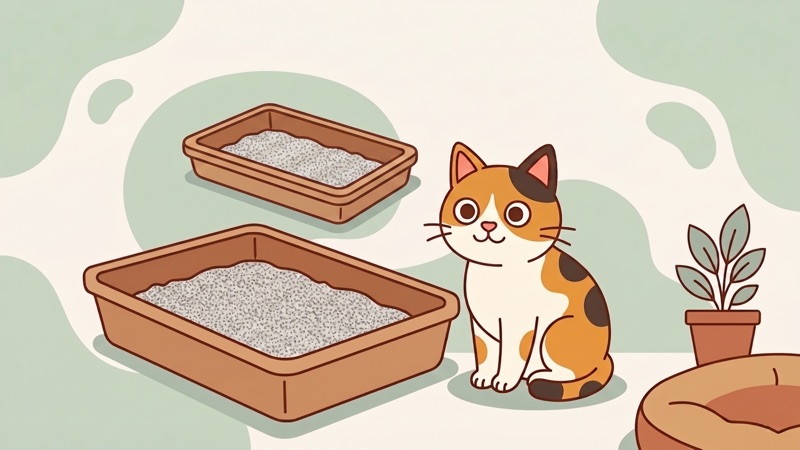
Litter boxes. One per cat plus one extra, placed in different locations. Two boxes side by side count as one. If one cat has to pass through the other’s favorite room to reach the box, that box might as well not exist. Litter box avoidance is one of the most common stress-related problems in multi-cat homes, and the fix is usually placement, not punishment.
Food and water. Separate stations in different rooms, or at least different corners. Feeding cats side by side works when they get along. When they don’t, one cat eats while stressed and the other waits.
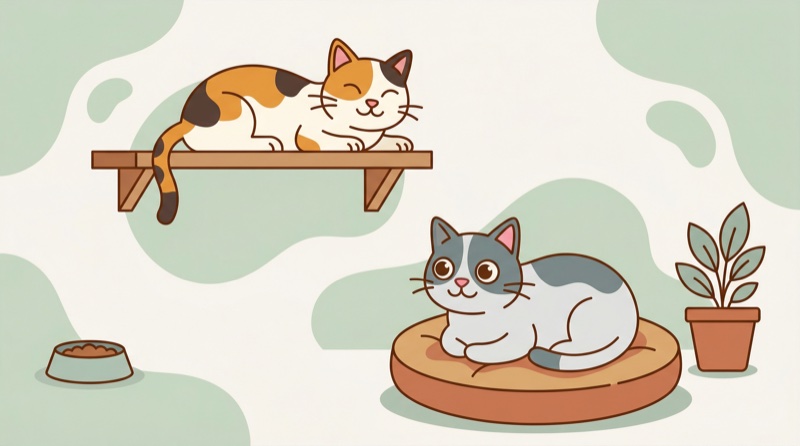
Vertical space. Cats that can’t spread out horizontally need to spread out vertically. Cat trees, shelves, and cleared-off furniture tops give cats room to coexist in the same square footage without being on top of each other. Height also provides safety. A cat on a shelf can observe without being cornered.
Safe retreats. Every cat needs at least one spot where the other cat won’t follow. Covered beds, closets, rooms with cat-flap-sized entries. If a conflict happens, the losing cat needs somewhere to go.
Scratching posts. In multiple locations. Scratching isn’t just nail maintenance. It’s scent marking. A cat that can’t scratch in its own territory feels less secure in it.
When it’s not working
Some signs that the introduction or the living arrangement isn’t going well:
One cat has stopped eating, or is eating significantly less. Weight loss in a multi-cat home should always prompt the question: is this cat being bullied away from food?
One cat hasn’t left a single room in over a week despite having access to the rest of the house.
Over-grooming or bald patches on either cat.
Urine marking (spraying on vertical surfaces). This is different from litter box avoidance. Spraying is a territorial statement, and in multi-cat homes it usually means one cat feels its territory is under threat.
Redirected aggression toward humans. A cat that can’t fight the other cat may redirect frustration onto the nearest person.
If you’ve followed the slow introduction protocol and these signs persist after six to eight weeks, the cats may not be compatible. That’s not a failure. Some cats genuinely don’t do well with other cats, and forcing it makes everyone miserable, both cats and you.
A veterinary behaviorist can sometimes find solutions that owners miss: medication for the more anxious cat, environmental changes that hadn’t been tried, or a modified reintroduction protocol. But sometimes the honest answer is that the cats need to live in separate spaces, which might mean separate rooms with a permanent door between them, or rehoming one cat to a household where it can be the only pet.
See a vet if: either cat stops eating for more than 24 hours, you notice blood in urine or straining in the litter box (which can indicate stress-related cystitis and can become an emergency in male cats), or one cat is physically injuring the other.
The shortest version of this article
Cats can live together, but they need a slow introduction, enough space, and enough stuff. Bring the new cat home into its own room. Let them smell each other for a few days before they see each other. Let them see each other through a barrier before they share space. Give each cat its own litter box, food station, water bowl, and a place to hide where the other cat won’t bother it. After all that, pay attention to the quiet signs of conflict: staring, blocking, avoidance. If both cats are eating well, sleeping in the open, and moving freely through the house, you’re probably fine. If one cat’s world has gotten smaller since the other arrived, something needs to change.
Frequently Asked Questions
How long does it take to introduce two cats? A proper slow introduction typically takes two to four weeks, though some cats need longer. The process involves keeping the cats in separate rooms first, then swapping scents, then allowing visual contact through a barrier, then supervised meetings, and finally unsupervised access. Rushing the process is the most common reason multi-cat introductions fail.
How many litter boxes do I need for two cats? The standard recommendation is one litter box per cat plus one extra, so three boxes for two cats. More importantly, the boxes should be in different locations. Two boxes placed side by side count as one from the cats’ perspective. Placing boxes so that neither cat has to pass through the other’s territory to reach one helps prevent litter box avoidance.
How do I know if my cats are fighting or playing? Play is usually silent, involves taking turns chasing, and both cats come back for more. Fighting involves vocalizing (hissing, growling, yowling), one cat consistently pinning or pursuing the other, puffed fur, and one cat trying to escape while the other follows. After play, both cats are relaxed. After a fight, one or both cats will hide or avoid the other. Also watch for silent conflict: staring, blocking doorways, and one cat monopolizing food or resting spots.
My cats have been together for months and still don’t get along. What should I do? If cats are still showing signs of conflict after six to eight weeks of a proper introduction, consider whether each cat has enough resources (separate litter boxes, food stations, hiding spots, and vertical space). Sometimes a complete reintroduction using the slow protocol helps. If conflict persists, consult a veterinary behaviorist. In some cases cats are simply not compatible, and the kindest option may be separate living spaces or rehoming one cat to a single-cat household.
References
- Crowell-Davis, S. L., Curtis, T. M., & Knowles, R. J. (2004). Social organization in the cat: A modern understanding. Journal of Feline Medicine and Surgery, 6(1), 19-28.
- Levine, E., Perry, P., Scarlett, J., & Houpt, K. A. (2005). Intercat aggression in households following the introduction of a new cat. Applied Animal Behaviour Science, 90(3-4), 325-336.
- Ellis, S. L. H., Rodan, I., Carney, H. C., Heath, S., Rochlitz, I., Shearburn, L. D., Sundahl, E., & Westropp, J. L. (2013). AAFP and ISFM feline environmental needs guidelines. Journal of Feline Medicine and Surgery, 15(3), 219-230.
- Bernstein, P. L., & Strack, M. (1996). A game of cat and house: Spatial patterns and behavior of 14 domestic cats (Felis catus) in the home. Anthrozoös, 9(1), 25-39.
- Bradshaw, J. W. S. (2016). Sociality in cats: A comparative review. Journal of Veterinary Behavior, 11, 113-124.
- DePorter, T. L., Bledsoe, D. L., Beck, A., & Ollivier, E. (2019). Evaluation of the efficacy of an appeasing pheromone diffuser product vs placebo for management of feline aggression in multi-cat households: a pilot study. Journal of Feline Medicine and Surgery, 21(10), 967-977.
- Cornell University College of Veterinary Medicine. Feline Behavior Problems. Cornell Feline Health Center