
Spaying and neutering is one of the first big decisions you make for a cat, and most owners come to it with the same questions: the right age, whether the surgery is safe, what recovery actually involves. Neutering is the general word for the procedure that stops a cat reproducing. In a female it is called spaying, the removal of the reproductive organs, and in a male it is castration, the removal of the testes. Both are done under general anaesthetic. This guide walks through why it is worth doing, the best time to do it, what surgery day looks like, and how to get your cat through recovery comfortably.
Why it’s worth doing
For a female cat, the biggest reason is cancer. Spaying before her first heat dramatically lowers her lifetime risk of mammary tumours, and that matters because mammary tumours are one of the most common cancers in cats and the large majority of them are malignant. The protection is strongest the earlier it is done and fades as a cat goes through more heat cycles. Spaying also takes away the possibility of pyometra, a uterine infection that fills the womb with pus and can turn life-threatening fast, along with other diseases of the uterus and ovaries. On the day-to-day side, it ends the heat cycle, the restless yowling, pacing, and rolling that an unspayed female goes through every few weeks.
This is also where one stubborn myth is worth clearing up. There is no health benefit to letting a female have a litter first. Waiting actually works against her, because every heat cycle she goes through before spaying chips away at that mammary cancer protection.
For a male cat, neutering removes the risk of testicular disease and quiets the behaviours driven by testosterone. Intact males roam, sometimes far from home, they fight with other cats, and they spray pungent urine to mark territory. Because roaming and fighting are how toms get hurt and how infections like FIV and feline leukaemia pass between cats through bites, taking away the urge to roam and fight lowers that exposure too.
None of this is only for outdoor cats. Pyometra and mammary tumours do not care whether a cat ever sets foot outside, and an unspayed female in heat is remarkably inventive about getting out of a door. Spraying and yowling are indoor problems as much as outdoor ones. An indoor-only cat benefits from the surgery just as much as any other.
The best time to do it
Veterinary thinking has shifted toward doing this earlier than many owners expect. The “Fix by Five” position, endorsed by the American Association of Feline Practitioners and a wide group of veterinary organisations, recommends spaying or neutering by five months of age. The logic is simple. Cats can reach sexual maturity and become pregnant from around four to five months old, so waiting much past that point risks an accidental litter before you have even scheduled the surgery.
Surgery at this age is quick and well tolerated. Kittens generally recover faster than older cats, and studies of early-age spay and neuter have found no rise in serious complications, as long as the kitten is healthy and over a minimum weight, usually around one kilogram. Think of five months as general guidance rather than a hard deadline. Your vet will look at your individual cat’s health, size, and growth before settling on a date, and the conversation fits naturally into the wider first weeks with a new kitten.
If you have taken in an adult cat whose history is a blank, do not assume the ship has sailed. Spaying and neutering can be done at any age, and a vet can check whether it has already been done and take care of it if not. It is a routine part of settling in a newly adopted adult cat.
What surgery day looks like
Before the day itself, your vet decides how much pre-surgery checking your cat needs. A young, healthy kitten may need little more than a physical exam. For an older cat, or one with any health concern, the vet may recommend bloodwork first to confirm it is safe to put them under anaesthesia.
You will be given fasting instructions, and they are worth following exactly, because the guidance differs depending on your cat’s age and the clinic’s protocol. Do not guess. Follow the times your own vet gives you.
The surgery is done under general anaesthesia. A spay involves a small incision, usually on the belly, and the surgery itself often takes only around fifteen to twenty minutes. A castration is quicker still, done through a tiny incision in the scrotum that is so small it frequently needs no skin stitches at all. Even so, plan to leave your cat at the clinic for most of the day. There is preparation beforehand and monitored recovery afterward, and they will not be ready to come home until the anaesthetic has worn off enough. If your cat is not already microchipped, ask about doing it during the same visit, since it can be done painlessly while they are already under.
Most cats go home the same day, groggy, quiet, and a little wobbly. That is normal, and it is the start of the part that depends most on you.
Recovery and aftercare at home
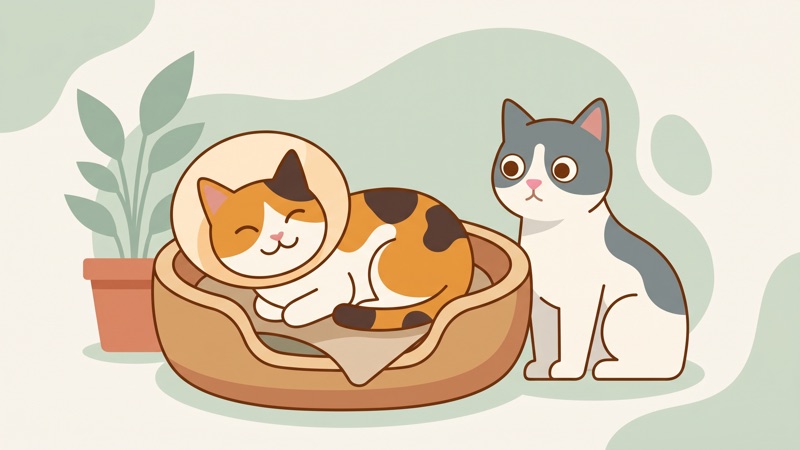
The single most important job during recovery is keeping your cat from licking or chewing the incision. A cat’s tongue is rough, the stitches are tempting, and a wound that gets worried at is the most common way healing goes wrong. The cone, the plastic Elizabethan collar, is not cruelty, it is the thing standing between your cat and a reopened incision. A soft recovery suit is a gentler alternative many cats tolerate better. Whichever you use, keep it on for as long as your vet advises.
Check the incision twice a day. A thin closed line, perhaps a little pink and slightly raised, is exactly what healing looks like. Keep the area dry, which means no baths during recovery, and keep your cat calm. Limit jumping, climbing, and rough play. A male cat is often back to himself within a couple of days, while a female, who has an incision in the abdominal wall, usually needs a week or two of quieter living before normal activity resumes.
A small detail that catches owners out is litter. During recovery, especially for a male with a scrotal incision, switch to a dust-free or paper-pellet litter so fine grit and dust cannot work their way into the healing wound. If your vet sends home pain medication, give it exactly as directed. Never reach for human painkillers. Paracetamol, also sold as acetaminophen, is especially dangerous to cats, and even a single tablet can be fatal; ibuprofen is toxic to them as well. Many vets close the incision with dissolvable sutures placed under the skin, but if your cat has visible skin stitches, you will be told when to bring them back to have them removed, usually somewhere around ten to fourteen days.
A quiet first evening with little appetite is normal. Most cats are eating and moving around much more like themselves by the next day.
When to call the vet during recovery
Contact your vet if the incision opens or gapes, oozes discharge or bleeds more than a spot or two, or becomes very red, swollen, or hot. Call as well if your cat stays lethargic beyond the first day, refuses food for more than about a day, vomits repeatedly, or seems to be in pain that the prescribed medication is not settling. These checks take seconds, and catching a problem early keeps a minor one from becoming serious.
Risks and complications
Spaying and neutering are among the most commonly performed surgeries in veterinary medicine, and they are generally very safe. That said, it is honest to acknowledge they are still surgery, done under anaesthesia. The possible complications are the ones any surgery carries: an uncommon reaction to the anaesthetic, some bleeding, infection of the incision, swelling, or a reaction to the sutures. Modern anaesthetic monitoring has made serious problems uncommon, and this is exactly why the pre-surgery assessment and the aftercare instructions matter. The point of naming these risks is not to alarm you. It is that the low risks of one routine operation sit against a lifetime of protection from cancers, infections, and unplanned litters.
Behaviour and weight after surgery
Owners often worry that surgery will change who their cat is. In practice, what changes is the hormone-driven behaviour, not the personality. A neutered cat tends to roam less, fight less, spray less, and, in females, stop the heat-cycle yowling. Many owners describe their cat as calmer and more affectionate afterward. The cat does not become dull or lose its character. A cat’s playfulness, curiosity, and chattiness come from temperament, not from reproductive hormones, and those stay exactly as they were.
The change that is real, and well documented, is metabolic. After neutering, a cat’s energy needs drop while its appetite often rises. The same bowl of food that kept an intact cat lean can quietly tip a neutered cat into gradual weight gain. Studies measuring this have found neutered cats put on noticeably more weight than intact cats when feeding is left unchanged.
The good news is that this is manageable, not inevitable. It does not mean neutering “makes cats fat”, it means their needs change and the feeding should change with them. After the surgery, ask your vet whether to reduce the portion or move to a food formulated for neutered cats, weigh your cat or check its body condition regularly rather than waiting for a problem to become obvious, and keep daily play in the routine. Our guide to a healthy cat weight covers how to do this without your cat feeling shortchanged at mealtimes.
How Furwise can help
Recovery has a few moving parts that are easy to lose track of: a medication or two on a schedule, an incision to check, a cone to keep on until a certain date. Furwise lets you set reminders for post-surgery medication so a dose is not missed, and log the surgery date so you know when the activity restriction is up. Further down the line, weight tracking is the quiet safeguard against post-neuter weight creep, catching it while it is still a small portion adjustment rather than a full diet.
Spaying and neutering is a decision that pays back over a cat’s whole life, in cancers avoided, infections sidestepped, and behaviours that never become a problem. Get the timing right, follow the aftercare closely for those first couple of weeks, and adjust the food bowl once the hormones settle, and you have given your cat a healthier, calmer life with very little fuss.
Frequently Asked Questions
What age should I spay or neuter my cat? The current veterinary recommendation, known as “Fix by Five”, is to spay or neuter by five months of age, before a cat reaches sexual maturity and before a female’s first heat. Cats can become pregnant from around four to five months old, so earlier is safer. Treat five months as guidance rather than a strict cutoff, and let your vet confirm the right date for your individual cat. If you have an adult cat that was never neutered, it can still be done at any age.
How long does it take a cat to recover from spay or neuter surgery? Male cats often seem back to normal within two or three days. Female cats, who have an incision in the abdominal wall, usually need a quieter week or two before returning to full activity. In both cases the incision generally heals over about ten to fourteen days. Keep the cone or recovery suit on, limit jumping and rough play, and check the incision twice a day for the whole of that period.
Will spaying or neutering change my cat’s personality? It removes hormone-driven behaviours such as roaming, fighting, urine spraying, and the heat-cycle yowling in females, and many cats become calmer and more affectionate. It does not make a cat dull or take away its character. Playfulness, curiosity, and temperament come from who the cat is, not from reproductive hormones, and those stay the same.
Does neutering make a cat fat? Neutering does not directly make a cat fat, but it does lower a cat’s energy needs and tend to increase appetite, so weight gain is common if the feeding is not adjusted afterward. It is preventable. Ask your vet about reducing the portion or switching foods after surgery, monitor your cat’s weight and body condition, and keep up daily play.
Does an indoor-only cat still need to be spayed or neutered? Yes. The health benefits, including protection from mammary tumours and pyometra in females and testicular disease in males, apply regardless of whether a cat goes outdoors. Indoor cats also escape more often than owners expect, especially a female in heat, and spraying and yowling are very much indoor problems.
Can I give my cat human pain medicine after surgery? No. Never give human painkillers to a cat. Paracetamol, also called acetaminophen, is especially dangerous, and even a single tablet can be fatal; ibuprofen is toxic to cats as well. If your cat seems uncomfortable after surgery, use only the pain medication your vet has prescribed, and call the clinic if it does not seem to be enough.
References
- Cornell Feline Health Center. Spaying and Neutering. Cornell University
- Cornell Feline Health Center. Mammary Tumors. Cornell University
- American Animal Hospital Association. The “Fix by Five” Initiative. AAHA Trends
- International Cat Care. Neutering Your Cat. iCatCare
- International Cat Care. Why Do I Need to Neuter My Cat? iCatCare
- Fettman, M. J., Stanton, C. A., Banks, L. L., et al. (1997). Effects of neutering on bodyweight, metabolic rate and glucose tolerance of domestic cats. Research in Veterinary Science, 62(2), 131-136. PubMed