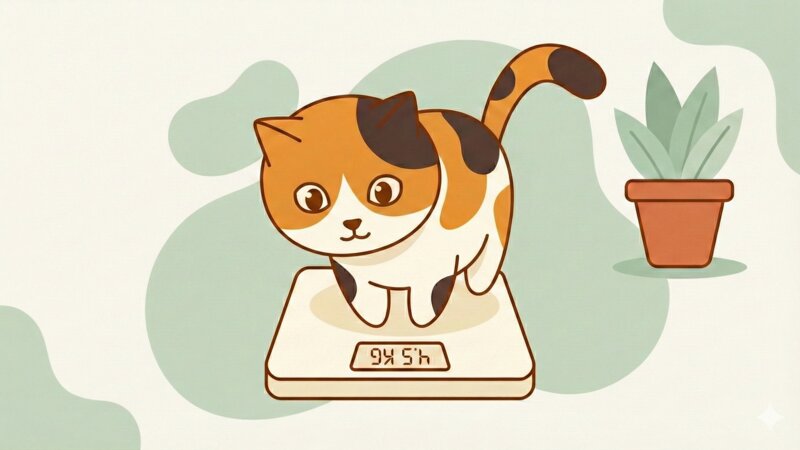
Is your cat at a healthy weight? Approximately 40-50% of domestic cats are overweight or obese, yet many owners don’t realize there’s a problem. And chubby cats look adorable, so we don’t always see it as a health concern. This guide shows you how to check your cat’s body condition yourself.
Why Weight Matters
Carrying extra weight drives up diabetes risk, wears out joint cartilage, strains the heart, raises anaesthetic risk, and shortens life.
| Health Risk | Details |
|---|---|
| Diabetes | Obese cats are about 4 times more likely to develop diabetes than cats at a healthy weight |
| Osteoarthritis | Extra weight accelerates joint cartilage wear, causing chronic pain |
| Cardiovascular strain | The heart has to work harder, increasing heart disease risk |
| Urinary problems | Obesity is associated with urinary tract disease |
| Anesthesia risk | Higher complication rates during surgery |
| Higher mortality | Obese cats aged 8-12 die at roughly 2.8 times the rate of lean cats |
Weight can be managed, though. The first step is figuring out where your cat actually stands.
Body Condition Score (BCS): More Important Than the Number on the Scale
Many people only look at the weight on the scale, but that’s not accurate enough. A 5 kg Maine Coon might be underweight, while a 5 kg mixed breed could already be overweight.
Veterinarians use “Body Condition Score” (BCS) to evaluate a cat’s body fat level. The most common system uses a 9-point scale, developed by the World Small Animal Veterinary Association (WSAVA).
How to Assess
Evaluating BCS requires both looking and feeling, checking three areas:
1. Ribs
- Gently run your palms over your cat’s rib area (don’t press hard)
- Ideal: You can easily feel the ribs, but can’t see obvious rib outlines
- Overweight: You need to press firmly to feel ribs, or can’t feel them at all
2. Waist
- View your cat from directly above
- Ideal: There’s a visible waist curve behind the ribs (like the top of an hourglass)
- Overweight: No visible waist; body appears oval or rectangular
3. Abdomen
- View from the side
- Ideal: The belly line tucks up slightly from chest to rear
- Overweight: Belly sags, or runs parallel to the ground
BCS Reference Chart
| Score | Condition | Characteristics |
|---|---|---|
| 1-3 | Underweight | Ribs, spine, and pelvis clearly visible; minimal fat covering |
| 4 | Lean | Ribs easily felt and may be slightly visible; obvious waist |
| 5 | Ideal | Ribs easily felt with slight fat covering. Waist visible from above; abdomen tucks up |
| 6 | Slightly overweight | Ribs require slight pressure to feel; waist less distinct |
| 7 | Overweight | Ribs difficult to feel; no waist; abdomen becoming rounded |
| 8-9 | Obese | Cannot feel ribs; obvious belly sag; body appears round from above |
Want a visual reference? See the official WSAVA Body Condition Score chart (PDF).
The goal is BCS 5. If your cat is at 6-7, it’s time to pay attention; at 8-9, consult your veterinarian soon.
Muscle Matters Too
Body condition score only evaluates fat, not muscle. Some cats can be both “overweight” and “muscle-wasted,” looking round overall while the spine and shoulder blades become prominent.
This is particularly common in cats over 10 years old. If you notice your cat’s back muscles have noticeably decreased, even if weight hasn’t dropped, consult your vet to rule out underlying health issues.
Why Cats Gain Weight Easily
Metabolic Changes After Neutering
Neutering lowers a cat’s calorie needs by roughly 20-25% while often increasing appetite. This means if you maintain the same feeding amount, weight gain is likely.
Talk to your vet about reducing food portions after neutering. A 20-25% cut is typical. For how to calculate daily calories from the RER formula and translate that into grams of food, see the cat feeding guide.
Free-Feeding
Leaving dry food out all day for cats to eat whenever they want is a major cause of obesity. In the wild, cats are “small, frequent meal” hunters, but faced with an endless food supply, many cats will overeat.
Switching to scheduled, portioned meals (2-3 times a day) helps a lot.
Indoor Lifestyle
Indoor cats are far less active than outdoor cats, naturally burning fewer calories. Add in lack of environmental stimulation, and some cats eat out of boredom.
More interactive play, vertical spaces, and puzzle feeders all help burn calories and fight boredom eating.
Owner Underestimation
This may be the biggest issue. Owners typically rate their cat’s body condition 1-2 points lower (better) than veterinarians do. When “slightly chubby” is seen as “normal,” the problem gets overlooked.
How to Help Your Cat Maintain a Healthy Weight
Dietary Adjustments
- 2-3 measured meals a day, not free-feeding
- Wet food over dry when possible: higher protein, lower carbs, and the water content (70-80%) helps with satiety
- Ask your vet about your cat’s daily calorie target
- Keep treats under 10% of daily intake
Increase Activity
- At least 15-20 minutes of interactive play daily, with wand toys and toys your cat can pounce on (finish a laser pointer session on something she can actually catch)
- Use food puzzles to make your cat “hunt” for meals
- Provide cat trees and vertical spaces
- In multi-cat homes, ensure adequate resources to prevent stress eating
Weight Loss Rate
If weight loss is needed, it must be gradual.
Important Warning
Cats must never lose weight rapidly. If a cat suddenly reduces food intake significantly, the body begins breaking down fat, which can lead to “hepatic lipidosis” (fatty liver disease), a potentially fatal condition.
A safe weight loss rate is 0.5-2% of body weight per week. A cat that needs to lose 1 kg may take 3-6 months to reach the goal safely.
Weight loss programs are best conducted under veterinary guidance, especially for obese cats at BCS 8-9.
When to See the Vet
Consider scheduling a veterinary consultation if:
- BCS reaches 7 or higher
- Weight has increased or decreased significantly in a short time
- Weight continues to rise despite dietary control attempts
- You’re unsure what your cat’s ideal weight should be
- You want to create a safe weight loss plan
Your vet can check for underlying issues like thyroid problems and help you put together a plan that fits your cat.
Tracking Weight Changes
A single weigh-in doesn’t tell you much. Weighing every 2-4 weeks and writing it down lets you spot trends before they become problems.
Weighing Tip
Use a baby scale, or hold your cat while standing on a scale (then subtract your own weight). Measure at the same time and under the same conditions each time for more accurate data.
Frequently Asked Questions
How do I know if my cat is overweight? Use the Body Condition Score system. Run your hands over the ribs, look at the waist from above, and check the belly from the side. If you can’t feel ribs without pressing hard, there’s no visible waist, or the belly sags, your cat is likely overweight (BCS 7+).
How fast can a cat safely lose weight? Slowly. Aim for 0.5-2% of body weight per week. A cat that needs to lose 1 kg might take 3-6 months. Rapid weight loss in cats can trigger hepatic lipidosis (fatty liver), which is life-threatening.
Do indoor cats get fat more easily? Yes. They burn fewer calories and some eat out of boredom. Scheduled meals, puzzle feeders, and daily interactive play help offset the difference.
Body condition score tells you more than the number on the scale. Get in the habit of checking ribs, waist, and belly every so often. Aim for BCS 5. If your cat is already over that, it’s fixable. Adjust the food, add some play, and give it time.
References
- WSAVA Global Nutrition Committee. (2020). Body Condition Score - Cat. WSAVA
- Cornell University College of Veterinary Medicine. (2024). Obesity. Cornell Feline Health Center
- Saavedra, C., et al. (2024). Overweight and obesity in domestic cats: epidemiological risk factors and associated pathologies. Journal of Feline Medicine and Surgery. PMC
- Teng, K.T., et al. (2018). Associations between neutering and obesity in domestic cats. Journal of Feline Medicine and Surgery, 20(12), 1054-1064.
- German, A.J. (2006). The growing problem of obesity in dogs and cats. The Journal of Nutrition, 136(7), 1940S-1946S. PubMed
- Scarlett, J.M., & Donoghue, S. (1998). Associations between body condition and disease in cats. Journal of the American Veterinary Medical Association, 212(11), 1725-1731. PubMed