Your cat just tested positive for FIV. The name alone sounds alarming, and you may be imagining the worst. But the reality of feline immunodeficiency virus is very different from what most people expect. Many FIV-positive cats live long, completely normal lives. This article covers what the virus actually does, how it spreads (and how it doesn’t), and what life with an FIV+ cat looks like in practice.
What FIV is
Feline immunodeficiency virus is a lentivirus, the same family as human HIV. The comparison ends there. FIV infects only cats. It cannot spread to humans, dogs, or any other species. There is no risk to you or your family from living with an FIV-positive cat (Cornell Feline Health Center, 2024).
FIV was first identified in 1986 at a cattery in Petaluma, California. Like HIV, it gradually attacks a specific type of immune cell (CD4+ T lymphocytes) that the body relies on to coordinate its defenses. Over time, this can weaken the cat’s ability to fight off infections. But the timeline is measured in years, often many years, and some cats never progress to the point of illness at all.
FIV is not the same as FeLV (feline leukemia virus). Despite both being feline retroviruses, they behave differently, spread differently, and have very different outcomes. FeLV is far more aggressive; most cats diagnosed with FeLV live about 2-3 years (Merck Veterinary Manual). FIV, by contrast, often doesn’t shorten a cat’s life at all.
How it spreads (and how it doesn’t)
The primary route of FIV transmission is deep bite wounds from fighting. The virus is present in saliva, and it takes the kind of puncture wound that injects saliva deep into tissue for transmission to occur. This is why unneutered outdoor males, the cats most likely to fight, have the highest infection rates.
What does not transmit FIV: sharing food bowls, water bowls, litter boxes, mutual grooming, sneezing, or casual social contact. The 2020 AAFP Feline Retrovirus Guidelines are explicit about this: non-aggressive contact does not efficiently transmit the virus (Little et al., 2020).
Mother-to-kitten transmission is rare. A shelter study following 19 kittens born to FIV-positive queens found zero vertical transmission (Litster, 2014).
Can FIV+ cats live with other cats?
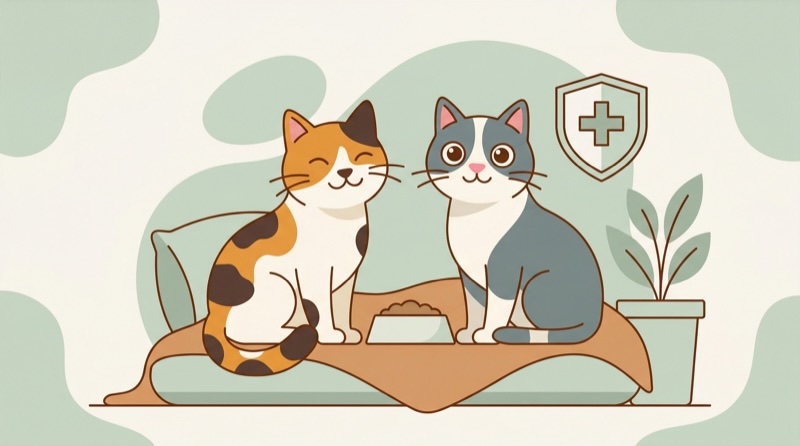
Yes, in most cases. Vets used to recommend strict separation, but that advice has changed. In a study tracking FIV-positive and FIV-negative cats living together in rescue shelters for a median of 28-38 months, not a single transmission event was documented (Litster, 2014). The 2020 AAFP guidelines state that “most cats in stable homes pose little risk for FIV transmission to other cats in the home.”
The key factor is household stability. Cats that get along and don’t fight pose minimal transmission risk. If your cats have a history of serious aggression toward each other, that’s a different situation, but normal hissing or the occasional swat is not the kind of fighting that transmits FIV.
How common is it
A 2024 review combining 113 studies estimated that roughly 1 in 11 cats worldwide test positive for FIV (Bezerra et al., 2024). Rates vary by region and population:
- Outdoor and stray cats have the highest rates (outdoor access is the single strongest risk factor)
- Male cats are roughly 2.5 times more likely to be positive than females
- Adult cats are about 2.8 times more likely than juveniles
- North America: around 3-6%, Western Europe: around 5%, Asia: around 12-14%
These numbers are based on testing populations, not the general pet cat population. Indoor-only cats in stable homes have very low infection rates.
Testing
How screening works
The standard first-line test is a quick in-clinic blood test (commonly called a SNAP test), such as the IDEXX SNAP FIV/FeLV Combo. It detects antibodies to FIV, not the virus itself. These tests are highly accurate, catching about 98% of truly infected cats while rarely giving a false alarm (Hartmann, 2017).
The 2020 AAFP guidelines recommend testing:
- When you first adopt or acquire a cat
- After exposure to a cat of unknown status
- Before vaccination
- When a cat becomes ill
When a positive test needs confirmation
A positive screening result in a low-risk cat (indoor-only, no bite wound history) should be confirmed with a second method, such as Western blot or IFA. A single positive SNAP test in a healthy, low-risk cat is not enough to declare a cat FIV-positive (Little et al., 2020).
PCR testing is sometimes used but has limitations. Cornell notes that PCR produces “relatively high numbers of false-positive and false-negative results.”
The kitten problem
Kittens born to FIV-positive mothers receive maternal antibodies through nursing. These kittens will test positive on antibody tests even if they aren’t actually infected. Maternal antibodies typically fade by 12-16 weeks of age but can sometimes persist longer.
If a kitten under 6 months tests positive, the test should be repeated at 60-day intervals until at least 6 months of age. A positive result after 6 months almost certainly reflects true infection (Cornell Feline Health Center, 2024).
The stages of FIV
FIV progresses through three general phases, though many cats never reach the final one.
Acute phase (weeks to months after infection). Lymph nodes may swell, and the cat may develop a mild fever or seem tired. Most owners never notice this stage, and it resolves on its own.
Asymptomatic carrier phase. This is where most FIV-positive cats spend most of their lives. The virus replicates slowly within immune cells, but the cat appears healthy and behaves normally. This phase can last years, and for some cats it lasts their entire life. A long-term study followed experimentally infected cats for over 13 years and found that some never progressed beyond this stage (Murphy et al., 2023).
Progressive immunodeficiency. If and when the immune system becomes significantly compromised, cats become susceptible to secondary infections and other conditions. Not all cats reach this point. When they do, the timeline from severe illness to death is typically months rather than years.
How long do FIV+ cats live?
The short answer: often just as long as any other cat. The old reputation of FIV as a killer doesn’t match what recent studies show.
A study of 1,205 cats in western Canada found that FIV-positive cats lived just as long as FIV-negative cats after diagnosis (Ravi et al., 2010). An Italian study tracking 53 FIV-positive pet cats found they lived more than 5.5 years on average after being diagnosed, with no significant difference in lifespan compared to uninfected cats (Spada et al., 2018).
Cornell’s Feline Health Center states: “Recent studies suggest that cats with FIV commonly live average life spans, as long as they are not also infected with feline leukemia virus.” The European Advisory Board on Cat Diseases (ABCD) titled a publication on the topic “FIV: not a death sentence.”
A 2024 expert survey of 10 FIV specialists found that half specifically emphasized that cats should not be euthanized based on FIV status alone, and that many FIV-positive cats “do not present with any disease” throughout their lives (Nehring et al., 2024).
One important caveat: cats infected with both FIV and FeLV at the same time do far worse. In the Italian study, cats positive for both viruses survived only about 77 days on average. This is why testing for both viruses matters.
When FIV does cause problems
The most common clinical issue in FIV-positive cats is oral disease, particularly chronic gingivostomatitis, a painful inflammation of the gums and mouth (Soltero-Rivera et al., 2023). Other conditions that can appear as immunity weakens include:
- Chronic or recurring upper respiratory infections
- Skin infections
- Weight loss
- Chronic diarrhea
- Eye inflammation
- Anemia or low white blood cell counts
- Lymphoma and other cancers (Murphy et al., 2023)
These are not inevitable outcomes. They’re possibilities that proper monitoring can catch early.
Living with an FIV+ cat
There is no cure for FIV, and no drug is registered specifically for treating it. Management is about keeping the cat healthy and catching problems early.
Keep them indoors. This protects your cat from exposure to other pathogens and prevents transmission to other cats in the neighborhood. Neutering or spaying also reduces the urge to roam or fight.
Prioritize dental care. Given the high incidence of oral disease, regular dental examinations and professional cleanings are especially important for FIV-positive cats.
Visit the vet at least twice a year. The 2020 AAFP guidelines recommend checkups every six months, including blood work and a urine test. Weigh your cat regularly at home too, as weight loss is often the first sign of trouble.
Feed a nutritionally complete diet. Avoid raw meat, raw eggs, and unpasteurized dairy. An immunocompromised cat is at higher risk from foodborne pathogens.
Reduce stress. Chronic stress can accelerate immune decline. Learning to recognize the signs of stress in cats early makes a real difference. A stable routine, adequate resources (litter boxes, food stations, resting spots), and minimal household disruption all help.
Don’t skip vaccinations. FIV-positive cats should still receive core vaccines. Their immune systems may respond less robustly, which makes protection from preventable diseases even more important. Discuss the vaccination schedule with your vet. For more on which vaccines matter and when, see our vaccination guide.
Treat illness promptly. Don’t take a wait-and-see approach with an FIV-positive cat. Infections that a healthy immune system might handle on its own can escalate quickly in an immunocompromised cat.
The FIV vaccine
An FIV vaccine (Fel-O-Vax FIV, Boehringer Ingelheim) was introduced in the US in 2002 but discontinued in North America by 2015-2017. As of 2024, it remained available only in limited markets (Australia, New Zealand, Japan), though supply issues have further reduced availability.
The vaccine was controversial for a specific reason: vaccinated cats develop antibodies that are indistinguishable from natural infection on standard antibody tests. These antibodies can persist for 7 or more years. This means a vaccinated cat will test positive on a SNAP test, and there’s no routine way to tell whether it’s truly infected or simply vaccinated. In shelters, this led to vaccinated cats being misidentified as FIV-positive and potentially euthanized.
Field effectiveness was also limited, estimated at about 56% in Australia (Westman et al., 2022). Nearly all FIV experts surveyed in a 2024 study did not recommend the vaccine (Nehring et al., 2024).
What you can do
If your cat has been diagnosed with FIV, the single most useful thing you can do is not panic. Read the research, not just internet forums. An FIV-positive diagnosis in 2026 is fundamentally different from what it meant 20 years ago.
If you’re considering adopting an FIV-positive cat from a shelter, know that these cats are often overlooked specifically because of the stigma around their diagnosis. They typically need nothing more than any other cat: regular vet visits, a good diet, a safe indoor environment, and someone who cares about them.
If your cat already lives with other cats and tests positive, talk to your vet about the specific dynamics in your household before making any drastic changes. In most stable, non-aggressive multi-cat homes, the risk of transmission is very low.
Frequently Asked Questions
Is FIV a death sentence for cats? No. Multiple studies show that FIV-positive cats commonly live normal lifespans. A study of over 1,200 cats found no significant difference in survival time between FIV-positive and FIV-negative cats. The European Advisory Board on Cat Diseases, Cornell University, and the 2020 AAFP guidelines all emphasize that FIV-positive cats can live long, healthy lives with proper care.
Can FIV-positive cats live with other cats? Yes, in most cases. FIV is transmitted through deep bite wounds from fighting, not through casual contact like sharing bowls, grooming, or using the same litter box. A study tracking FIV-positive and FIV-negative cats living together for years found zero transmission events. The key is a stable household where cats do not engage in serious fighting.
Can FIV spread to humans? No. FIV is completely species-specific and infects only cats. There is no evidence that FIV can infect or cause disease in humans, dogs, or any other species. You can safely live with, pet, and care for an FIV-positive cat with no risk to yourself or your family.
How is FIV in cats diagnosed? The standard screening test is a point-of-care antibody test (SNAP or ELISA). A positive result in a low-risk cat should be confirmed with a second method such as Western blot. Kittens under 6 months may test falsely positive due to maternal antibodies and should be retested at 60-day intervals until at least 6 months old.
References
- Little, S., Levy, J., Hartmann, K., Hofmann-Lehmann, R., Hosie, M., Olah, G., & St Denis, K. (2020). 2020 AAFP Feline Retrovirus Testing and Management Guidelines. Journal of Feline Medicine and Surgery, 22(1), 5-30.
- Cornell University College of Veterinary Medicine. (2024). Feline Immunodeficiency Virus (FIV). Cornell Feline Health Center
- Bezerra, J. A. B., et al. (2024). Global seroprevalence and factors associated with seropositivity for FIV. Preventive Veterinary Medicine, 231, 106315.
- Nehring, M., Dickmann, E. M., Billington, K., & VandeWoude, S. (2024). Study of FIV prevalence and expert opinions on standards of care. Journal of Feline Medicine and Surgery, 26(7).
- Murphy, B. G., et al. (2023). The Late Asymptomatic and Terminal Immunodeficiency Phases in Experimentally FIV-Infected Cats. Viruses, 15(8).
- Litster, A. L. (2014). Transmission of FIV among cohabiting cats in two cat rescue shelters. Veterinary Journal, 201(2), 184-188.
- Spada, E., et al. (2018). Survival time and effect of selected predictor variables in cats with feline immunodeficiency virus and feline leukemia virus. Preventive Veterinary Medicine, 152, 39-47.
- Ravi, M., et al. (2010). Naturally acquired feline immunodeficiency virus (FIV) infection in cats from western Canada: prevalence, disease associations, and survival analysis. Canadian Veterinary Journal, 51(3), 271-276.
- Soltero-Rivera, M., et al. (2023). Feline chronic gingivostomatitis: current concepts. Journal of Feline Medicine and Surgery, 25(7).
- Hartmann, K. (2017). Performance of 4 Point-of-Care Screening Tests for Feline Immunodeficiency Virus and Feline Leukemia Virus. Journal of Veterinary Internal Medicine, 31(3).
- Westman, M. E., et al. (2022). FIV infection in domestic pet cats in Australia and New Zealand: guidelines for diagnosis, management, and control. Australian Veterinary Journal, 100(8), 345-359.