

One day you pick up your cat and notice their chin looks dirty. Little black specks, like ground pepper, stuck to the skin. You try to wipe them off but they don’t budge. That’s not dirt. It’s feline acne, and it’s one of the most common skin conditions in cats.
What it actually is
Feline acne is a keratinization disorder. Hair follicles on the chin produce too much keratin (a protein in the skin), which plugs the follicle opening and forms a comedone, basically a blackhead. The chin is especially prone because it has a high concentration of sebaceous glands and cats can’t groom it well on their own.
A 2010 retrospective study of 74 cats with chin acne found no breed, sex, or age predilection. Any cat can get it (Scott & Miller, 2010). About 58% of cases stay mild, just comedones that don’t need treatment. The other 42% develop secondary bacterial infection and progress to something more uncomfortable.
Mild vs. serious
Black specks with no redness are the mild comedonal stage, and home care is usually enough. Redness, swelling, or pus means a vet visit.
Mild (comedonal stage)
- Black specks along the chin and lower lip
- The area may feel slightly gritty or oily
- Cat isn’t bothered by it
- This can persist indefinitely without getting worse
Moderate to severe (infected)
- Red, swollen bumps (papules or pustules)
- Hair loss around the chin
- Crusting, bleeding, or oozing
- Cat scratching at the chin or rubbing it on surfaces
- In bad cases, the chin becomes visibly swollen and painful (furunculosis)
If your cat is in the mild category, home care is usually enough. Once it’s red, swollen, or the cat seems uncomfortable, that’s a vet visit.
What causes it
The honest answer: nobody knows exactly. Veterinary dermatology textbooks classify feline acne as idiopathic, meaning the root cause isn’t clear (Miller et al., 2013). But several contributing factors are well-established:
Plastic bowls are the most commonly cited trigger. Plastic scratches easily, and those scratches harbor bacteria. (Our hydration guide covers bowl choice in more detail.) Every time your cat eats or drinks, their chin presses into a surface covered in bacterial biofilm. There’s no controlled study proving this definitively, but the clinical observation is consistent enough that switching bowls is standard veterinary advice.
Poor chin hygiene plays a role. Cats can’t easily lick their own chin, so oil and debris accumulate there more than on other parts of the body.
Stress and immune factors may contribute in some cats. Anything that affects the immune system or hormonal balance can potentially worsen sebaceous gland activity.
Secondary bacteria make things worse once they get involved. A study of 22 cats found bacteria (mainly staph) in 45% of cases and Malassezia yeast in 18% (Jazic et al., 2006). These don’t cause the acne but they turn mild comedones into painful infections.
How to treat it at home
For mild cases (just black specks, no redness or swelling):
- Switch to stainless steel or ceramic bowls. Most vets recommend starting here. Wash them daily.
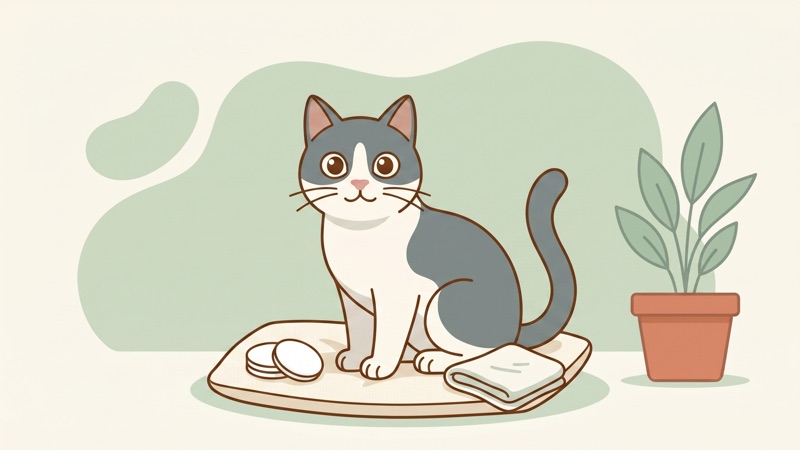
- Warm compress. Soak a clean cloth in warm water, hold it against the chin for a few minutes to soften the plugs. Do this once or twice a day.
- Gentle cleaning. After the compress, gently wipe the chin with a damp cloth. Don’t pick at the comedones or squeeze them.
- Don’t over-treat. Mild chin acne is mostly cosmetic. If your cat isn’t bothered and there’s no redness, aggressive scrubbing does more harm than good.
Avoid using human acne products (benzoyl peroxide, salicylic acid) unless your vet specifically recommends a formulation safe for cats. Concentrations that work on human skin can irritate or burn cat skin.
When to see the vet
See a vet if you notice
- Red, swollen, or painful bumps on the chin
- Crusting, bleeding, or discharge
- Your cat scratching at the chin frequently
- Chin swelling that’s getting worse
- No improvement after 2-3 weeks of home care
Your vet may prescribe topical antibiotics (mupirocin showed good results in a 25-cat trial by White et al., 1997), medicated wipes, or in severe cases systemic antibiotics. They’ll also want to rule out other conditions that can look similar, like flea dirt, fungal infection, or eosinophilic granuloma complex.
It’s related to stud tail
Feline acne and stud tail (supracaudal gland hyperplasia) are actually the same type of problem in different locations. Both involve overactive sebaceous glands and follicular keratinization. Stud tail shows up as greasy, matted fur at the base of the tail, sometimes with blackheads. The chin version is just more visible because the fur there is shorter.
If your cat has both chin acne and a greasy tail base, that’s consistent. The underlying mechanism is the same.
Frequently Asked Questions
Are the black spots on my cat’s chin flea dirt? Maybe, but probably not if they’re stuck to the skin. Flea dirt is loose and smears reddish-brown when you wet it (that’s digested blood). Chin acne comedones are embedded in the skin and don’t wipe off easily. If you’re not sure, the wet paper towel test works: dab a wet white paper towel on the specks. Red-brown smear = flea dirt. No color change = likely acne.
Can I pop my cat’s chin blackheads? No. Squeezing comedones can push bacteria deeper into the follicle, turning a mild cosmetic issue into a painful infection. Warm compresses and gentle wiping is the safer approach.
Will switching from plastic to metal bowls actually fix it? It helps a lot of cats. It’s not guaranteed to cure it because the underlying cause is multifactorial, but it removes one of the most commonly cited contributing factors. Stainless steel or ceramic, washed daily, is what most vets recommend as the first step.
References
- Scott, D. W., & Miller, W. H. (2010). Feline Acne: A Retrospective Study of 74 Cases (1988-2003). Japanese Journal of Veterinary Dermatology, 16(4), 203-209. J-STAGE
- Jazic, E., et al. (2006). An evaluation of the clinical, cytological, infectious and histopathological features of feline acne. Veterinary Dermatology, 17(2), 134-140. PubMed
- White, S. D., et al. (1997). Feline acne and results of treatment with mupirocin in an open clinical trial: 25 cases. Veterinary Dermatology, 8(3), 157-164. PubMed
- Miller, W. H., Griffin, C. E., & Campbell, K. L. (2013). Muller and Kirk’s Small Animal Dermatology, 7th ed. Elsevier.
- International Cat Care. (2023). Acne and Stud Tail. iCatCare