Your cat’s litter box is a daily health check. Stool shape, color, and consistency often shift before any other sign of illness. A quick glance each day catches things while they’re still small problems.
The Bristol stool scale
The Bristol Stool Scale, developed for humans in 1997, works just as well for tracking a cat’s stool consistency. Its value is giving you and your vet a shared vocabulary for “softer than last week” or “harder than usual.”
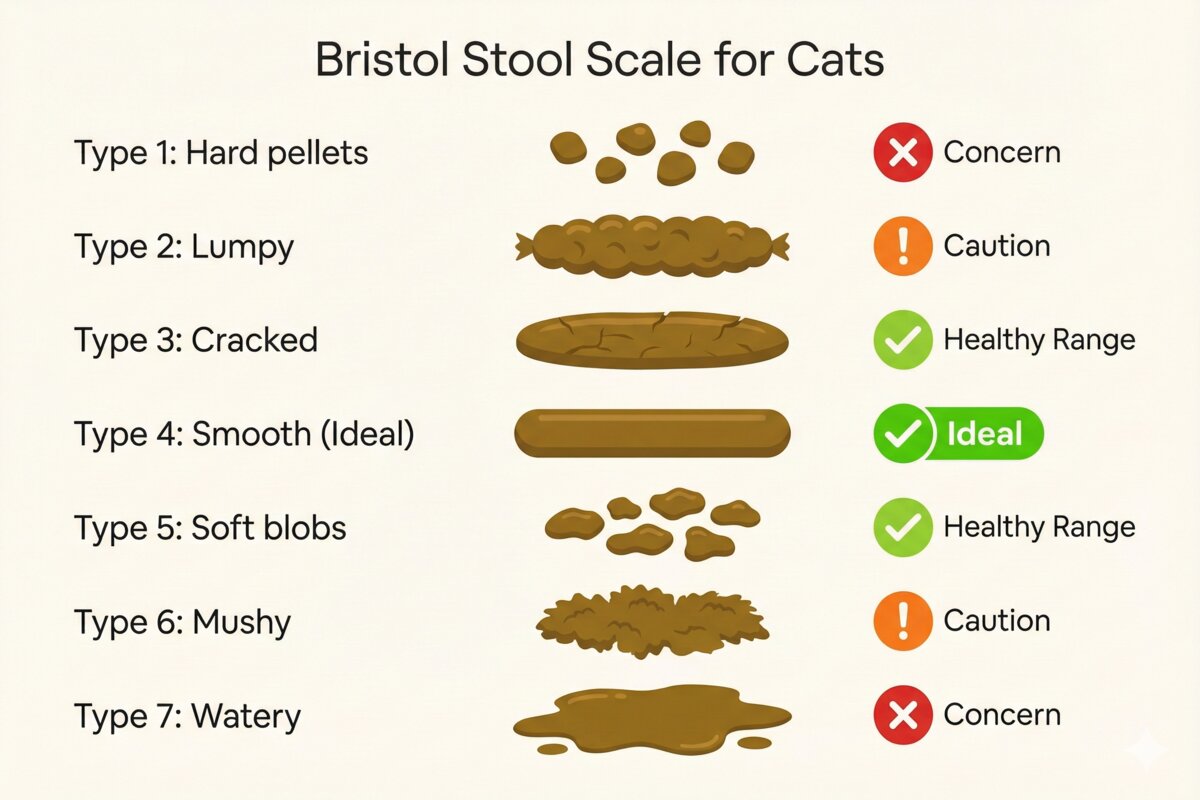
The Bristol Stool Scale adapted for cats
| Score | Shape | What It Means |
|---|---|---|
| 1 | Hard pellets, like small stones | Severe constipation |
| 2 | Lumpy sausage shape | Mild constipation |
| 3 | Sausage with cracks | Normal range, slightly firm |
| 4 | Smooth sausage or snake | Ideal |
| 5 | Soft blobs with clear edges | Normal range, slightly soft |
| 6 | Mushy, fluffy pieces | Mild diarrhea |
| 7 | Watery, no solid form | Diarrhea |
Most healthy cats produce a 3 or 4 consistently. A score of 5 in an otherwise well cat usually isn’t urgent. Persistent 1–2 or 6–7 over more than a day is worth a vet call.
What color tells you
Color matters as much as shape. Normal is brown. If it turns black, red, or grey, take a closer look.
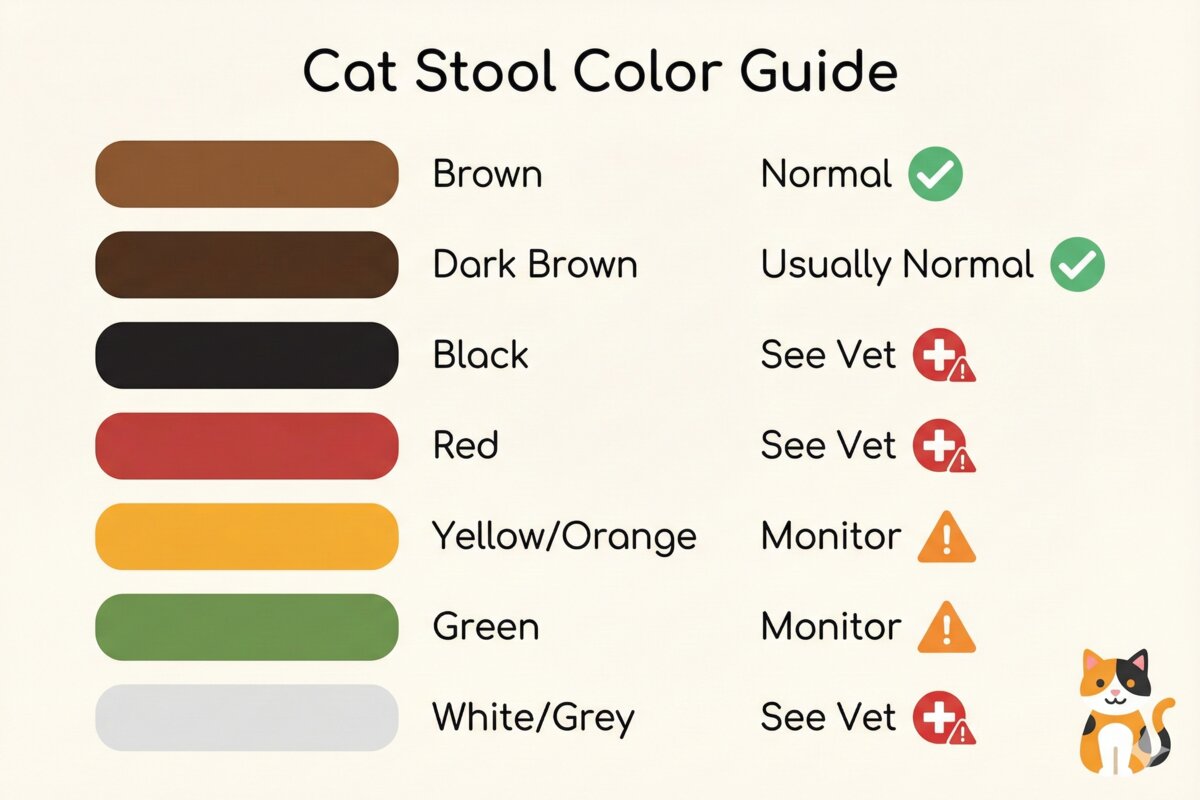
What different stool colors may indicate
| Color | Status | Possible Causes |
|---|---|---|
| Brown | Normal | Healthy digestion |
| Dark brown | Usually normal | High-protein diet |
| Black, tarry | See vet promptly | Upper GI bleeding, iron supplements |
| Red, bloody | See vet | Lower GI bleeding, anal fissures, colitis |
| Yellow, orange | Monitor | Liver or gallbladder issues, food intolerance |
| Green | Monitor | Bile changes, eating grass, fast transit |
| White, grey | See vet | Bile-duct blockage, exocrine pancreatic problems |
| Mucus coating | Monitor | Colon inflammation, parasites |
What you might find in the stool
Small white rice-grain segments suggest tapeworm; thin spaghetti-like worms can be roundworm. If you see anything moving, bag a sample and bring it to your vet.
A little dark hair in the stool now and then is normal, just fur swallowed during grooming. If it starts showing up often, your cat may be grooming more than usual, which is worth keeping an eye on.
If you see string, ribbon, or dental floss coming out of your cat’s rear, never pull it. The other end may be caught further up inside, and pulling can injure the gut. Leave it alone and get to a vet the same day.
When soft stool keeps coming back
A single soft stool after a treat, a new food, or a stressful day often settles on its own. What matters is whether it persists.
If your cat has had soft stool, on and off or constantly, for more than two to three weeks, treat it as a longer-term gut problem worth a vet workup. The common causes are:
- Food sensitivity. Some cats react to ingredients in their food. Switching to a vet-recommended prescription diet often clears it up within a few weeks. Common in younger cats.
- Parasites. Bugs like Giardia cause ongoing soft stool that looks like ordinary diarrhea but won’t clear without the right treatment.
- Chronic gut inflammation. Usually considered after food and parasites are ruled out; sometimes a biopsy is needed to confirm.
- Intestinal lymphoma. More common in older cats, usually alongside gradual weight loss, vomiting, and soft stool.
Your vet typically starts with a fecal panel, bloodwork, and a diet trial before moving to imaging or biopsy. Don’t wait three months hoping it resolves on its own.
Diet transitions and stress
Switching foods can cause a few days of softer stool, even when there’s nothing wrong with the new food, because the gut needs time to adjust. So take it slow, over 7 to 10 days: start at 25% new food, increase to 50%, then 75%, then 100%. Rushing the switch is the usual culprit, and the easiest to avoid.
Stress also shows up in the litter box. Boarding, a move, a new pet, or a visitor can all loosen things temporarily. If your cat is otherwise eating, drinking, and acting normal, give it a few days before calling the vet.
What to watch changes with age
Kittens, adults, and seniors each need watching for different things.
- Kittens dehydrate fast. Diarrhea in a kitten under 6 months, especially with vomiting or lethargy, can become a same-day emergency in under 24 hours. Don’t wait it out.
- Watch for change in adults. Healthy adult cats are fairly steady, once or twice a day. If a cat who goes daily suddenly stops for several days, or goes far more often, take note.
- Seniors tend toward constipation. And it’s often driven by something else: kidney disease, not drinking enough, or arthritis that makes the box hard to use. A senior who hasn’t passed stool in 48 hours, or strains without producing, should see a vet before you reach for over-the-counter fiber.
When to see a vet
Most stool changes resolve in a day or two. But if you see the signs below, see a vet, and some of them mean going the same day.
Schedule a visit:
- Bristol 1–2 (constipation) or 6–7 (diarrhea) lasting more than 24 hours
- Yellow, green, or persistently abnormal color
- Mucus or small blood streaks without other signs
- Soft stool that has been going on more than 2–3 weeks
- Pooping outside the litter box without a clear environmental cause
Same-day or emergency:
- Black tarry stool combined with pale gums, weakness, or collapse
- Bright red blood with frequent watery diarrhea, especially with vomiting
- A kitten with diarrhea plus vomiting or refusal to eat
- Visible rectal prolapse
Straining cat ≠ constipation: rule out urinary blockage first
If your male cat keeps straining in the litter box, look beyond constipation and check whether he’s actually unable to pee. A blocked urethra causes the same straining, and it’s dangerous: it can turn fatal within 24 to 48 hours, so if you suspect it, get to the vet right away.
What to look for: little or no urine (or just a few drops), crying in the box, constant licking down there, a hard tense belly. If you can’t tell whether he’s trying to poop or pee, treat it as a urinary emergency and go.
Bringing a stool sample to the vet
If your cat is having GI signs, a fresh stool sample saves a return visit.
- Fresh matters. Samples within 12 to 24 hours are best. Older than that and parasites can be missed.
- Refrigerate, don’t freeze. Freezing can affect Giardia test results. Refrigerate unless your vet says otherwise.
- A little litter stuck on is fine. Don’t try to rinse it. Just bag it.
- Pea-sized is enough for fecal flotation, PCR panels, or smear.
Your vet can use the sample to check for parasites, infections, and more. Having one shortcuts a lot of guesswork.
How Furwise can help
Nobody wants to stare at cat poop every day trying to remember if it looked different last week. Furwise tries to make this easier. Take a photo and the app estimates a Bristol score, notes color changes, and keeps a timeline. When something looks off, you have a record to share with the vet instead of relying on memory.
Frequently Asked Questions
What does healthy cat poop look like? A Bristol 3 or 4: smooth or slightly cracked, brown, holds its shape. Not rock-hard, not watery, no mucus coating, no visible blood.
How often should a cat poop? Once or twice a day for most adult cats. Some go every other day on a very digestible diet, which can be normal. Going several days without stool, or going much more often than usual, warrants attention.
How long can a cat go without pooping? Up to 48 hours is usually still in the normal range, especially if your cat ate less than usual or is dehydrated. Past 48 to 72 hours, or any straining without output, see a vet. Senior cats and cats with kidney disease tend toward constipation and need closer monitoring.
Why does my cat have soft poop after switching food? Diet changes loosen stool because the gut needs time to adjust. A 7 to 10 day gradual transition usually prevents this. Mild soft stool in the first week of a switch is expected; if it lasts more than two weeks, the food may not suit your cat.
Why is my cat pooping outside the litter box? This can be stool-related (constipation, urgency from diarrhea, pain associating the box with discomfort) or environmental (dirty box, recent move, multi-cat tension, litter type change). If it started suddenly and your cat is also straining, has soft stool, or seems off, treat it as a medical sign first, behavior second.
Can I give my cat probiotics for soft stool? Possibly helpful, but evidence is mixed. Research on feline probiotics shows variable effects depending on strain, dose, and the underlying condition. Cat-specific products with strains like Enterococcus faecium SF68 have some supporting data. Avoid human yogurt and unverified supplements. Probiotics are not a substitute for a vet workup if soft stool has lasted weeks.
References
- Lewis SJ, Heaton KW. (1997). Stool form scale as a useful guide to intestinal transit time. Scandinavian Journal of Gastroenterology, 32(9), 920-924.
- Marsilio S, Freiche V, Johnson E, et al. (2023). ACVIM consensus statement guidelines on diagnosing and distinguishing low-grade neoplastic from inflammatory lymphocytic chronic enteropathies in cats. Journal of Veterinary Internal Medicine, 37(3), 794-816.
- Pilla R, Gaschen FP, Barr JW, Olson E. (2025). Probiotic, prebiotic, synbiotic, and postbiotic supplementation in cats: a systematic review. Journal of Small Animal Practice.
- Whittemore JC, Stokes JE, Price JM, Suchodolski JS. (2017). Effects of a synbiotic on the fecal microbiome and metabolomic profiles of healthy research cats administered clindamycin. Journal of Feline Medicine and Surgery, 21(8), 770-779.
- Washabau RJ, Day MJ. (2013). Canine and Feline Gastroenterology. Elsevier Saunders.
- Cornell Feline Health Center. (2024). Gastrointestinal Parasites of Cats. Cornell University.
- International Cat Care. (2023). Digestive System Problems in Cats. icatcare.org